
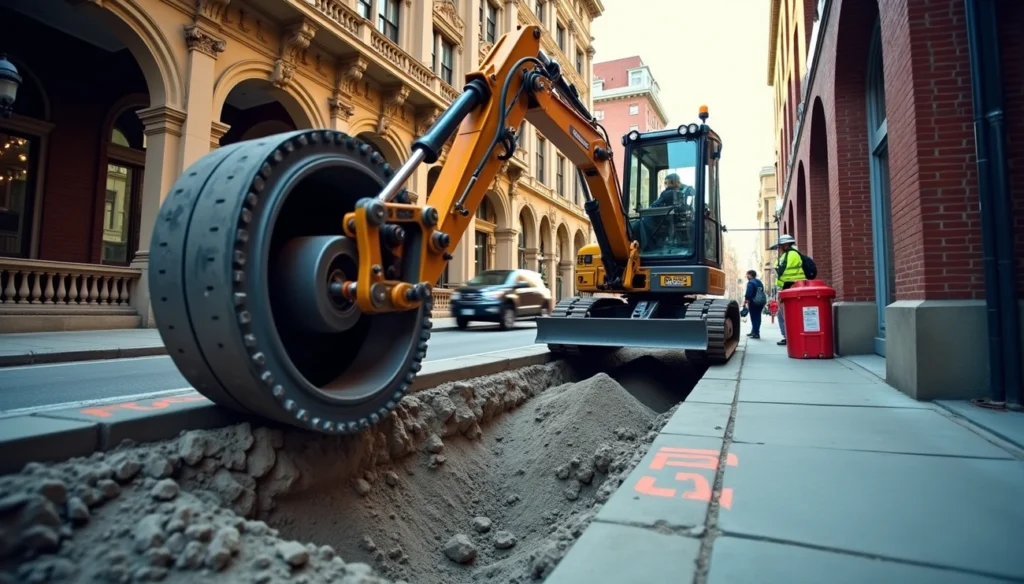

Rock wheel in low vibration technology offers a superior solution for urban excavation projects where precision and minimal disruption are paramount. When compared to traditional excavation methods like hydraulic hammers, rockwheels provide more precise control over the quality and structure of excavation projects. This advantage becomes especially critical in sensitive urban environments where noise and vibration constraints can make or break a project’s success.
In addition to addressing wheel vibration at low speeds, rockwheels significantly improve overall performance while reducing the rock in wheel noise that typically disrupts urban neighborhoods. Furthermore, these versatile attachments serve multiple functions across construction, demolition, mining, and utility applications, with an impressive capability spanning 12 different applications including trenching, foundation excavation, profiling, underwater work, and even landscaping. By enhancing functionality while simultaneously lowering costs and improving efficiency, we’ve found rockwheels to be invaluable tools for urban projects where traditional excavation methods fall short.
Urban Excavation Challenges: Why Traditional Methods Fall Short

Image Source: Eagle Rock Excavating
Traditional excavation methods present significant challenges in urban settings where sensitivity to surrounding environments is crucial. These limitations become particularly evident across several critical dimensions.
Noise and Vibration Concerns in Residential Areas
Construction vibrations create major disturbances in urban residential areas. Notably, humans perceive vibrations at levels much lower than those required to damage structures—feeling vibrations at just 0.011 in/sec while categorizing them as “severe” at 0.301 in/sec. Despite this perception, actual structural damage typically begins at 0.50 in/sec for older homes with plaster-on-lath construction and 0.75 in/sec for newer drywall homes. Construction activities generating the most problematic vibrations include site clearing, soil compaction, and deep foundation installation. Consequently, even when structural damage isn’t occurring, residents experience discomfort, stress, and potential health issues from prolonged exposure.
Precision Requirements for Utility-Dense Environments
Urban excavation occurs in environments densely packed with underground infrastructure. Failing to maintain proper clearance between digging equipment and underground utilities causes 13.46% of damages to buried infrastructure annually in the United States. Moreover, utility strikes can lead to dangerous service disruptions and costly repairs. Within designated tolerance zones, contractors must employ hand tools or non-destructive excavation methods such as hydro or vacuum excavation to safely expose existing utilities.
Space Constraints in Congested Urban Settings
Tight spaces represent a fundamental challenge in urban excavation projects. Limited room for equipment maneuvering and material storage necessitates specialized approaches. Mini-excavators and vacuum excavation methods allow for precise digging without damaging surrounding areas. Additionally, excavation crews must implement proper shoring techniques to prevent trench collapses, particularly important given the mixed soil types commonly found in urban environments.
Environmental and Regulatory Compliance Issues
Environmental regulations add another layer of complexity. Projects disturbing one or more acres require Clean Water Act permit coverage for stormwater runoff. This involves obtaining National Pollutant Discharge Elimination System permits and developing Storm Water Pollution Prevention Plans. Construction compliance rules also include daytime-only operations for high-noise equipment, vibration limits, and mandatory reporting. Missing even one requirement across environmental compliance, land use permitting, air quality, or construction regulations can cause expensive delays and reputation damage.
Rockwheel Technology: Engineering for Urban Sensitivity

Image Source: TradeEarthmovers
Engineered specifically for urban environments, rock wheel in low vibration technology represents a fundamental shift in excavation methodology. Unlike conventional equipment, Rockwheels operate on principles that prioritize precision and minimal environmental impact.
How Rockwheels Minimize Wheel Vibration at Low Speeds
Rockwheels utilize advanced hydraulic flow systems that deliver precise control with minimal vibration, even at low operational speeds. The key engineering feature lies in how all picks connect with cutting surfaces at a 45-degree angle, pressing into material rather than pounding it. This approach effectively eliminates the typical impact energy associated with traditional breakers, resulting in substantially reduced machine vibration and virtually no ground-transmitted impact noise.
Cutting Mechanism vs. Impact-Based Excavation
The fundamental difference between Rockwheels and conventional methods is their cutting action versus impact force. Rather than relying on destructive hammering, Rockwheels systematically chip away material by pressing picks into the surface. This eliminates over-breakage since adjacent structures remain unaffected by the cutting process. The evenly distributed teeth further extend equipment lifespan by spreading impact forces across the machine.
Size and Attachment Options for Different Carriers
Rockwheel attachments accommodate virtually any project scale, from the compact C2 model (the world’s smallest twin header) to larger G45 units with integrated gearboxes for heavy-duty applications. These attachments fit excavators ranging from under 10 tons to 125-ton carriers, with adapter systems enabling quick switching between different sized units. Optional 360-degree rotating heads allow for detailed excavation at virtually any angle.
Operational Control and Precision Capabilities
The precision control capabilities make Rockwheels particularly valuable for sensitive projects. Their design enables millimeter-accurate excavation with consistent trench widths regardless of depth. This level of control allows operation near existing structures without transmitting disruptive vibrations. Impressively, Rockwheels perform three to five times faster than hydraulic hammers in medium-hard rock conditions, all while producing uniformly sized spoil material that enhances backfill density.
Measurable Performance Advantages in Urban Projects
Concrete performance data demonstrates why rock wheel in low vibration technology outperforms traditional excavation methods across all measurable metrics.
3-5x Faster Execution Than Hydraulic Hammers
Rockwheels process materials at rates up to 300 tons per hour, whereas conventional methods struggle to exceed 120 tons. In practice, rockwheels cut through material 3-5 times faster than hydraulic hammers in medium-hard rock conditions. This speed advantage stems primarily from the continuous cutting action versus the stop-start nature of impact-based excavation.
Precision Cutting: Achieving Millimeter Accuracy
The design ensures trenches maintain exact drum width regardless of depth. This precision eliminates over-breakage, as evidenced by projects where adjacent structures remain completely undisturbed. Essentially, rockwheels deliver controlled, predictable results where hammers create unpredictable fracture patterns.
Material Quality: From Waste to Reusable Resource
Unlike traditional methods that produce irregular waste, rockwheels create uniform gravel-sized material that can be immediately repurposed. This transformation from disposal burden to usable resource reduces hauling costs while eliminating the need for imported backfill.
Noise Reduction: Eliminating the Rock in Wheel Noise Problem
The low-noise design allows night work in urban settings with strict sound restrictions. Subsequently, projects progress without the delays typically caused by limited working hours in noise-sensitive areas.
Project Timeline and Cost Impact Analysis
Beyond direct excavation benefits, rockwheels reduce overall project timelines through faster execution and fewer environmental delays. Indeed, the economic advantages include lower maintenance costs for equipment due to reduced vibration stress.
Read other Articles – Who is Giancarlo Giammetti? The Man Who Built Fashion’s Greatest Empire
Real-World Applications: Urban Success Stories

Image Source: Eagle Rock Excavating
Successful urban projects demonstrate how rock wheel in low vibration technology delivers practical benefits in challenging environments. These real-world applications highlight the advantages beyond theoretical performance metrics.
Utility Trenching in Residential Neighborhoods
A West Virginia contractor facing the challenge of trenching through 3 feet of sandstone underlain by 3.5 feet of blue limestone utilized a D20 Rockwheel attachment on a 20-ton excavator. The project required precision to avoid damage to existing utility lines. During this residential project, homeowners actually brought cookies to the crew—the first time trenching hadn’t rattled their windows. The accuracy of rockwheels makes them vital when working above underground utilities like pipes and cables, preventing damage to critical infrastructure.
Foundation Work Adjacent to Historic Structures
When limestone bedrock needed deepening immediately adjacent to an adjoining building footer, contractors chose rockwheels primarily because hydraulic hammers would have created damaging shock waves through the rock mass and concrete. One resident noted, “The foundation of our new house gave us big problems. The material was much too hard for ordinary excavation. The Rockwheel made light work of the job – and is extremely quiet”. Excavator operators likewise prefer rockwheels, as Marius Schmitt observed: “You immediately notice there is less wheel vibration at low speeds”.
Road Reconstruction in High-Traffic Areas
Infrastructure projects often extend over long distances, requiring exceptional equipment flexibility. In asphalt and concrete cutting applications, rockwheels provide accuracy unattainable with hydraulic breakers, thus eliminating over-excavation. The gravel-sized residual material can be reused on-site as substructure or refill for trenches, saving substantial disposal and transportation costs.
Underground Parking Excavation Case Study
A three-dimensional finite element model analysis of an underground parking garage renovation near a hotel demonstrated how deep excavation affects adjacent structures. The five-floor underground garage required excavation to a depth of 16 meters. Through careful engineering and use of precision equipment, vertical displacement of strip foundations was limited to -5.2 mm and -10.98 mm respectively for buildings A and B, well within acceptable tolerances for structural integrity.
Conclusion
Rock wheel technology stands as a game-changing solution for urban excavation challenges where traditional methods simply fall short. Throughout this examination, we’ve seen how rockwheels effectively address the fundamental limitations that typically plague city construction projects. Their cutting mechanism, as opposed to impact-based excavation, significantly reduces the vibration issues that cause resident complaints and potential structural damage to surrounding buildings.
The performance advantages speak for themselves. Rockwheels work three to five times faster than hydraulic hammers while simultaneously achieving millimeter-accurate cutting precision. This combination of speed and accuracy proves especially valuable when working near existing utility infrastructure or historic structures. Additionally, the uniform, gravel-sized material produced during excavation transforms what would typically be waste into a reusable resource, cutting project costs and reducing environmental impact.
Perhaps most importantly for urban applications, the dramatic reduction in noise and vibration allows projects to continue even in noise-restricted areas or during extended hours. The real-world applications demonstrate why rockwheel technology has become essential for sensitive urban environments – from foundation work near historic buildings to utility trenching in residential neighborhoods without disrupting homeowners.
Certainly, the initial investment in rockwheel technology exceeds that of traditional excavation equipment. However, the overall project savings through faster completion times, reduced material handling costs, and fewer regulatory delays ultimately deliver better financial outcomes. As urban development continues to intensify and environmental regulations become increasingly stringent, rockwheels offer contractors a solution that balances efficiency with sensitivity to surrounding environments.
The evidence clearly shows that for urban excavation projects where precision matters and disruption must be minimized, rock wheel technology delivers undeniably superior results compared to traditional methods.
FAQs
Q1. How does rock wheel technology differ from traditional excavation methods? Rock wheel technology uses a cutting mechanism instead of impact-based excavation, resulting in significantly reduced vibration and noise. It offers precision cutting with minimal disruption to surrounding areas, making it ideal for sensitive urban environments.
Q2. What are the main advantages of using rock wheels in urban construction projects? Rock wheels offer several advantages including faster execution (3-5 times quicker than hydraulic hammers), millimeter-accurate cutting, reduced noise and vibration, and the production of reusable gravel-sized material instead of waste.
Q3. Can rock wheels be used near existing structures or utilities? Yes, rock wheels are particularly suitable for work near existing structures and utilities. Their precision and low vibration allow for excavation adjacent to buildings and underground infrastructure without causing damage or disruption.
Q4. How do rock wheels impact project timelines and costs? Rock wheels can significantly reduce project timelines due to faster execution and fewer environmental delays. While the initial investment may be higher, overall project costs are often lower due to increased efficiency, reduced material handling, and fewer regulatory issues.
Q5. Are rock wheels suitable for different types of urban excavation projects? Rock wheels are versatile and can be used in various urban excavation projects, including utility trenching, foundation work, road reconstruction, and underground parking excavation. They are adaptable to different carrier sizes and can perform multiple functions across construction, demolition, and utility applications.
Interested in similar content or opportunities. Contact Us