
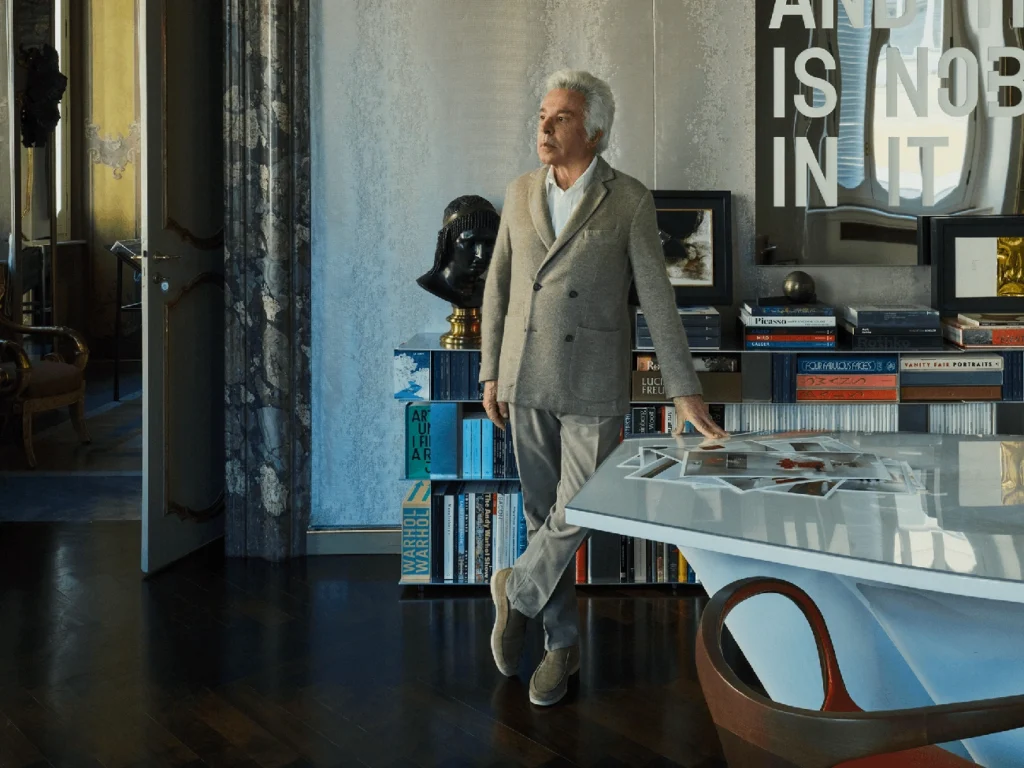

Giancarlo Giammetti stands as one of fashion’s most influential yet understated figures, transforming the Valentino brand into a global powerhouse that sold for an impressive $300 million in 1998. While his name might not be as instantly recognizable as his lifelong business partner Valentino Garavani, his business acumen shaped the trajectory of one of the world’s most celebrated fashion houses.
Behind the iconic red dresses and glamorous runway shows lies a remarkable partnership that began in the 1960s. The Italian businessman co-founded the Valentino fashion house with Valentino Garavani, creating a brand so valuable it was later acquired by the Marzotto group for $210 million in 2002[-2]. Furthermore, their impact extends beyond fashion, as they established the Fondazione Valentino Garavani e Giancarlo Giammetti in 2016 to support charitable and cultural endeavors. We often overlook the business minds behind creative geniuses, but Giammetti’s story proves that successful fashion empires require both artistic vision and strategic brilliance.
In this article, we’ll explore the life of the man who helped build fashion’s greatest empire, from his early years through his fateful meeting with Valentino to their transformation of a small Italian atelier into a global phenomenon.
The Early Years: From Rome to Architecture
Born amid the turmoil of World War II, Giancarlo Giammetti entered the world in Rome on February 5, 1942. His arrival coincided with one of history’s most challenging periods, yet this backdrop would ultimately shape the resilient business mind behind fashion’s greatest empire.
Family background and upbringing
The young Giammetti grew up in a comfortably middle-class household in Rome’s distinguished neighborhoods. His father owned an electronics store near the famous Via Veneto, providing a stable foundation for his family during post-war Italy’s economic recovery. Raised specifically in Rome’s Salario quarter, Giammetti experienced the city during what many consider its most glorious modern period – the era immortalized in Federico Fellini’s “La Dolce Vita.”
As one of three children, Giancarlo enjoyed the privileges of Italy’s emerging post-war bourgeoisie. In his own words, he described himself as “a very spoiled kid—very Italian, very Roman”. This upbringing in Rome’s haut bourgeois Parioli section instilled in him an appreciation for esthetics and quality that would eventually transform the fashion world.
His early lifestyle reflected the comfortable existence of Italy’s middle class during this period. “My first car, a Fiat 500, was given to me by my father—it was that kind of life, which was very bourgeois in Italy at the time,” Giammetti once recalled. His youth consisted of typical teenage pursuits: “Sitting in the café waiting for the time when the nightclub opens and going dancing until the early morning”.
Education at Collegio San Gabriele
Giammetti’s formal education began at Collegio San Gabriele in Rome, where he attended liceo classico – Italy’s traditional high school curriculum focused on humanities, including Latin, ancient Greek, literature, and philosophy. This rigorous educational foundation provided him with a strong appreciation for classical esthetics and cultural history that would prove invaluable in his future career.
The Collegio San Gabriele, known for its disciplined approach to education, shaped young Giancarlo’s worldview during his formative years. This prestigious institution emphasized not only academic excellence but also the cultural sophistication that characterized Italian education of the era.
Despite his privileged upbringing and quality education, Giammetti maintained a somewhat rebellious spirit toward his studies. “In fact, my life was about trying to not study, trying to not go to university,” he once admitted, revealing the independent streak that would eventually lead him away from traditional career paths.
Initial interest in architecture
After completing his studies at Collegio San Gabriele, Giammetti pursued higher education at a local faculty of architecture. He enrolled specifically at the Università di Architettura La Sapienza in Rome, one of Italy’s most prestigious institutions for architectural studies.
His interest in architecture represented more than just an academic pursuit – it reflected his natural eye for proportion, balance, and esthetic harmony. These fundamental principles of architectural design would eventually translate perfectly into the structured world of high fashion, where silhouette and form reign supreme.
When he encountered Valentino Garavani in 1960, Giammetti was in his second year of architecture school. At just 18 years old, the architecture student was still living at home with his parents, balancing his studies with the vibrant social life Rome offered during this golden age.
The discipline of architectural training gave Giammetti a unique perspective that differed from traditional fashion business approaches. His education taught him to envision complete structures, considering both artistic vision and practical execution – a mindset that would prove essential when building a fashion empire from the ground up.
Nevertheless, Giammetti ultimately abandoned his architectural studies when the opportunity to join forces with Valentino presented itself. “He gave up academics when he met the charismatic Valentino, who had just returned from Paris and the two decided to open their company in 1960”. This pivotal decision marked the beginning of a partnership that would transform not just their lives, but the entire landscape of international fashion.
Through these formative years in Rome, studying architecture, and experiencing the cultural renaissance of post-war Italy, Giancarlo Giammetti developed the foundation of skills, sensibilities, and vision that would eventually help him construct one of fashion’s greatest empires alongside his lifelong business partner.
Read other Articles – How Van de Graaff’s Failed Engineering Career Led to a Nobel-Worthy Invention
Meeting Valentino: The Start of a Fashion Empire

Image Source: Yahoo
A chance encounter in Rome’s bustling café scene would forever change the landscape of global fashion. The partnership between Giancarlo Giammetti and Valentino Garavani stands as one of the industry’s most enduring collaborations, spanning over six decades of creative and business synergy.
The iconic 1960 meeting on Via Veneto
The fateful meeting occurred on July 31, 1960, at the glamorous Café de Paris on Rome’s fashionable Via Veneto. Giammetti, then a young architecture student, was sitting alone when Valentino, who had recently returned from Paris, approached his table. “I was a young architecture student, and that July day I was there with some friends,” Giammetti recalled. “Valentino was returning from Paris, he spoke to me in French, he still does”.
Upon discovering they were both planning vacations to Capri, they agreed to meet again on the island ten days later. This chance encounter amid Rome’s dolce vita atmosphere—where celebrities like Sophia Loren, Gina Lollobrigida, and Marcello Mastroianni frequently gathered—marked the beginning of an extraordinary journey.
Early romantic and business partnership
Initially, Giammetti visited Valentino’s atelier “just for fun,” yet he soon began taking an interest in the business affairs. Their partnership quickly evolved beyond friendship. “I was just 22 years old when I met Valentino. I didn’t know about fashion, didn’t know about finance. I didn’t know anything about this world,” Giammetti confessed.
Valentino recognized Giammetti’s natural business acumen immediately. “I believe in destiny. That evening in Via Veneto I met a person. Immediately I liked him very much and told him he had a fantastic character. He was well educated, and that was very important”. Consequently, Giammetti abandoned his architectural studies to fully commit to Valentino’s vision.
Launching the Valentino brand
The duo established Maison Valentino in 1960, creating a partnership that would ultimately define Italian luxury fashion. Their beginning was humble yet ambitious. “In the beginning, we had few resources. We sublet an apartment on Via Gregoriana which we used as an atelier and to welcome the ladies of the time”.
Giammetti’s business insights proved crucial to the brand’s early success. He convinced Valentino to showcase their collection in Florence in 1962, a strategic move that catapulted them onto the international stage. “My first year, people were interested in me because I was new,” Valentino recalled. “Then the press started to come… But I didn’t have buyers, and the international press at that moment was all in Florence. Finally, Giancarlo figured out that we had to go to Florence”.
Elizabeth Taylor became one of their first high-profile clients when she requested a dress for the Rome premiere of “Spartacus” in 1961, significantly boosting their visibility.
The first red dress: Fiesta and its symbolism
The iconic Valentino red—now registered as its own Pantone color—originated with “Fiesta,” a strapless cocktail dress of draped tulle from Valentino’s debut Spring/Summer 1959 collection. This distinctive hue, officially a mix of 100% magenta, 100% yellow, and 10% black, became the brand’s most recognizable signature.
Valentino’s fascination with red began during his youth while attending opera in Barcelona. “I saw a woman with gray hair in one of the boxes, very beautiful, dressed in red velvet. Among all the colors worn by the other women, she looked unique, isolated in her splendor,” he once explained.
Giammetti acknowledged the superstitious element behind making red a constant feature: “Valentino has superstitions that became status symbols. He did red once, and now you have red in every collection,” he told Vogue in 1985. “Most of our statements came to be because we are romantic; we don’t like to throw away things we like or that bring good luck”.
The enduring partnership between Giancarlo Giammetti and Valentino Garavani transformed a modest fashion house into a global empire through their complementary talents—Valentino’s creative genius paired with Giammetti’s business savvy.
Conclusion
The partnership between Giancarlo Giammetti and Valentino Garavani stands as a testament to how business intelligence and creative genius can combine to create something truly extraordinary. Throughout their six-decade collaboration, Giammetti transformed from an architecture student with no fashion knowledge into the strategic mastermind behind one of the world’s most prestigious luxury brands. His decision to abandon his studies after that chance meeting at Café de Paris undoubtedly altered fashion history forever.
While Valentino crafted breathtaking designs that captured imaginations worldwide, Giammetti worked tirelessly behind the scenes, orchestrating the business operations that allowed those creations to flourish. This balance proved essential to their success—Valentino focused on his artistic vision while Giammetti handled the practical realities of building a global fashion house.
The iconic Valentino red became much more than a color choice under their guidance. Instead, it evolved into a powerful brand signature recognized worldwide. This strategic consistency, championed by Giammetti, helped establish a clear visual identity that set them apart from competitors. Their approach to business reflected a perfect blend of Italian romanticism and sharp commercial instinct.
Despite remaining less visible than his famous partner, Giammetti’s influence on fashion extended far beyond the Valentino label. His business model—pairing creative talent with strong business leadership—became a template many luxury fashion houses would later adopt. Additionally, his foresight in recognizing the importance of celebrity endorsements, starting with Elizabeth Taylor, pioneered marketing strategies still used today.
The eventual $300 million sale of their fashion empire certainly validated Giammetti’s business acumen. Nevertheless, their partnership transcended mere commercial success. Together, they created not just beautiful clothes but a lasting legacy that continues to influence fashion decades later.
Ultimately, Giancarlo Giammetti’s story reminds us that behind every creative genius often stands an equally brilliant business mind. His journey from that fateful meeting on Via Veneto to building a global fashion powerhouse demonstrates how vision, partnership, and persistence can transform an industry. Though he may have stayed in Valentino’s shadow publicly, his contributions shine just as brightly in fashion history.
FAQs
Q1. How did Giancarlo Giammetti meet Valentino Garavani? Giancarlo Giammetti met Valentino Garavani on July 31, 1960, at the Café de Paris on Rome’s Via Veneto. They struck up a conversation and agreed to meet again in Capri, marking the beginning of their lifelong partnership.
Q2. What was Giancarlo Giammetti’s role in the Valentino fashion empire? Giammetti was the business mastermind behind the Valentino brand. He handled the company’s financial and strategic operations, allowing Valentino to focus on design. His business acumen was crucial in transforming Valentino from a small atelier into a global fashion powerhouse.
Q3. What is the significance of the color red in Valentino’s designs? The iconic “Valentino red” originated with a dress called “Fiesta” from the brand’s debut collection. It became a signature color for the brand, appearing in every collection. The specific shade is registered as its own Pantone color, symbolizing the brand’s luxury and distinctiveness.
Q4. How did Giancarlo Giammetti’s background influence his work in fashion? Although Giammetti initially studied architecture, his education provided him with an eye for proportion and esthetics that translated well into fashion. His middle-class Roman upbringing also instilled in him an appreciation for quality and style that proved valuable in the luxury fashion world.
Q5. What was one of Giammetti’s key business strategies for Valentino? One of Giammetti’s crucial strategies was recognizing the importance of celebrity endorsements. He helped secure Elizabeth Taylor as one of their first high-profile clients in 1961, which significantly boosted the brand’s visibility and set a precedent for future marketing approaches in the fashion industry.
Interested in similar content or opportunities. Contact Us