
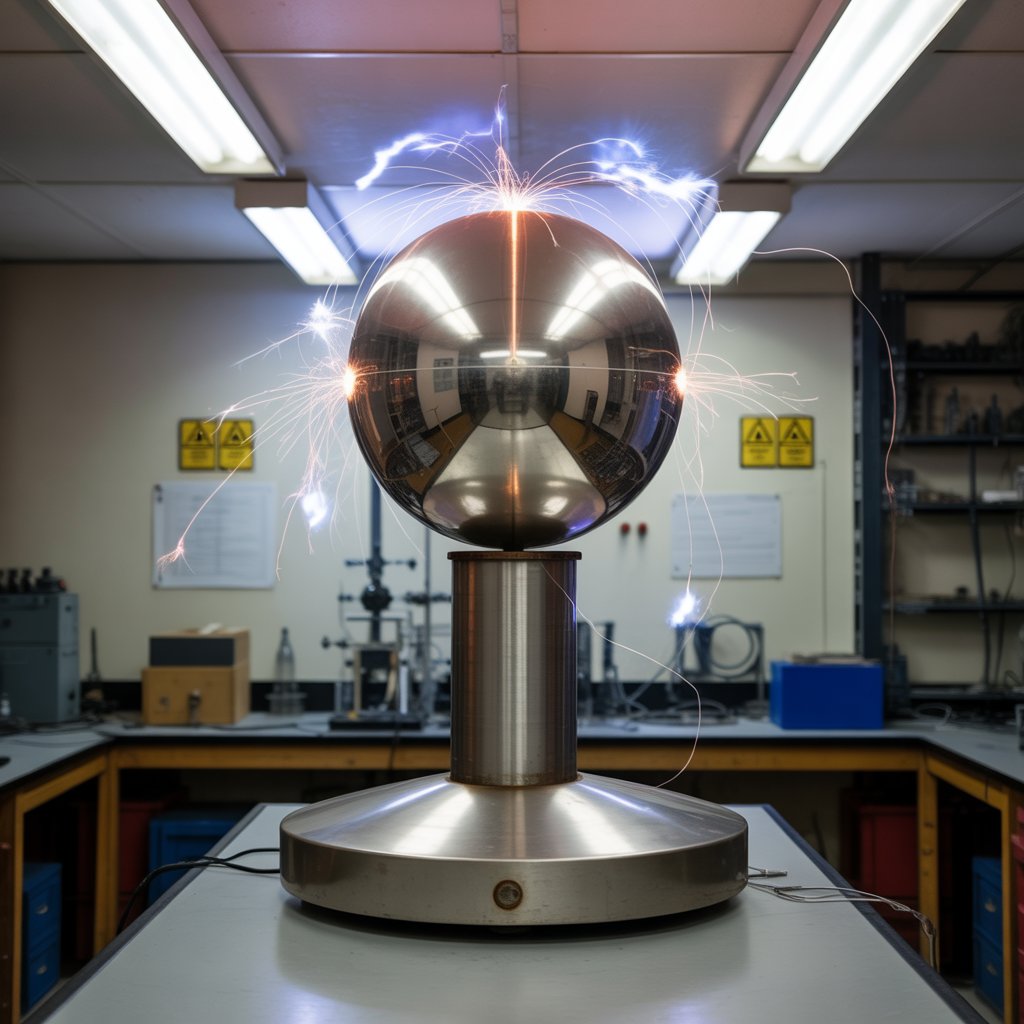

Have you ever wondered how a career setback could lead to a revolutionary scientific breakthrough? The van de graaff generator, capable of producing an astonishing 7 million volts by 1933, began with a much humbler first model generating just 80,000 volts in 1929. What makes this invention even more remarkable is the journey of its creator.
Robert J. Van de Graaff initially demonstrated a 1.5-million-volt model in 1931, more than doubling the highest direct current voltage previously achieved. Furthermore, his work continued to evolve, with properly enclosed machines eventually producing potentials reaching approximately 13 million volts. The impact of the van de graaff machine extended far beyond laboratory demonstrations. In fact, by 1967, more than 500 high-voltage Van de Graaff generators were operating worldwide, with installations in hospitals and laboratories across 30 countries. These generators weren’t just scientific curiosities—they represented significant advancements in accelerator technology for nuclear physics, radiation therapy, and industrial applications.
In this article, we’ll explore how dr van de graaff’s unexpected career path led him from engineering disappointment to creating one of physics’ most enduring and useful inventions. We’ll trace robert van de graaff’s journey from the University of Alabama to Princeton, examining how his failure in one field ultimately led to extraordinary success in another.
From Power Plants to Paris: The End of Van de Graaff’s Engineering Career
Robert Van de Graaff’s journey toward creating his famous generator began with a solid foundation in engineering, though his path would take unexpected turns. His early career choices ultimately set the stage for his later scientific contributions.
Mechanical Engineering at University of Alabama (1922–1923)
The young Van de Graaff displayed exceptional aptitude for technical subjects during his time at the University of Alabama. Between 1922 and 1923, he immersed himself in mechanical engineering coursework, developing a strong theoretical understanding of machines, energy transfer, and electrical systems. These foundational concepts would later prove invaluable, despite his shift away from traditional engineering.
During this period, he particularly excelled in mathematics and physics-adjacent engineering courses. Although seemingly satisfied with his educational path at this stage, Van de Graaff was already developing an intellectual curiosity that extended beyond practical applications toward more fundamental questions about electricity and energy.
Work at Alabama Power Company and Observations on Magnetic Circuits
Following his education, Van de Graaff secured a position at Alabama Power Company, where he encountered real-world engineering challenges. While working there, he made several key observations about magnetic circuits and the practical limitations of power generation and transmission systems.
His daily work involved solving practical problems, yet he found himself increasingly drawn to the theoretical aspects. Throughout this time, Van de Graaff meticulously observed how high-voltage systems operated, noting their inefficiencies and limitations. Though he couldn’t have known it then, these observations were planting seeds for his future invention.
Why He Left Engineering: Dissatisfaction and Curiosity
Despite his promising start, Van de Graaff gradually realized that conventional engineering couldn’t satisfy his deeper scientific curiosity. Practical applications alone failed to address the fundamental questions about electricity that truly fascinated him.
Moreover, he felt constrained by engineering’s focus on immediate applications rather than pushing theoretical boundaries. This growing dissatisfaction, coupled with his natural inquisitiveness about foundational physics principles, prompted him to make a bold decision.
Subsequently, Van de Graaff left behind his engineering career, setting his sights on Paris—a center of scientific advancement. This dramatic career shift would ultimately lead him toward the field of physics, where his engineering background would give him a unique perspective on solving scientific problems.
A Shift Toward Physics: Academic Rebirth in Europe

Image Source: Facebook
In 1924, armed with a state-funded grant, Robert J. Van de Graaff embarked on an intellectual journey that would profoundly reshape his career. Leaving behind his engineering position, he ventured to Paris to pursue studies at the prestigious Sorbonne.
Marie Curie’s Lectures at the Sorbonne and the Geiger Counter Moment
At the Sorbonne, Van de Graaff experienced a pivotal moment when he attended Marie Curie’s captivating lectures on radioactivity. These presentations ignited his fascination with atomic physics, effectively steering him away from engineering toward fundamental scientific inquiry. Remarkably, it was the sound of individual alpha particles clicking on a Geiger counter during these lectures that Van de Graaff later cited as the inspiration for his life’s work. This singular experience—hearing the discrete detection of subatomic particles—crystallized his interest in nuclear physics.
Rhodes Scholarship and Oxford Studies under J.S.E. Townsend
The trajectory of Van de Graaff’s academic rebirth accelerated in 1925 when he secured a prestigious Rhodes Scholarship to Queen’s College at Oxford University. Under the guidance of distinguished physicist J.S.E. Townsend, he immersed himself in advanced physics studies. Throughout his time at Oxford, Van de Graaff occasionally felt intimidated by his erudite colleagues, many of whom spoke three languages fluently. Nevertheless, he excelled academically, earning a bachelor’s degree in physics in 1926 followed by a doctorate in 1928.
Conversations with J. Robert Oppenheimer on Proton Scattering
Additionally, a significant intellectual exchange occurred in 1926 when Van de Graaff shared accommodation with J. Robert Oppenheimer at the University of Leiden for a week. During their late-night conversations, Oppenheimer discussed theoretical aspects of proton scattering, whereas Van de Graaff contemplated possibilities for electrostatic accelerators. This exchange undoubtedly influenced his thinking as he began conceptualizing his generator.
At Oxford, Van de Graaff also became familiar with Ernest Rutherford’s groundbreaking work in nuclear physics, which further solidified his interest in particle acceleration.
Read other Articles – Why Aedes Australis Mosquito Survives Only in New Zealand’s Coastal Areas
The Van de Graaff Generator: From Tin Can to 7 Million Volts
The practical manifestation of Robert J. Van de Graaff’s theoretical work began with astonishingly modest materials. After returning from Europe, he needed to prove his concepts worked before seeking substantial funding.
First Working Model at Princeton (1929): 80,000 Volts
At Princeton in 1929, working under Karl T. Compton, Van de Graaff constructed his first generator using only a tin can, silk ribbon, and small motor—costing barely $90. Remarkably, this simple device generated 80,000 volts, limited only by corona discharge from the can’s edges.
1.5 Million Volt Demonstration at AIP (1931)
By November 1931, Van de Graaff had refined his design to produce over 1.5 million volts—more than doubling any previous direct-current source. He demonstrated this achievement at the American Institute of Physics inaugural dinner, nervously explaining his invention with Compton at his side.
Round Hill Generator and the 5.1 MV Milestone
Consequently, with Research Corporation funding, Van de Graaff constructed a massive generator at Round Hill in South Dartmouth. Though designed to reach 10 megavolts, it achieved 5.1 megavolts due to insulation limitations. Still, on November 28, 1933, it produced impressive forty-foot sparks before an audience of scientists and journalists.
Uniform-Field Electrode Configuration for Beam Control
Throughout World War II, Van de Graaff developed uniform-field electrode configurations for acceleration tubes, significantly improving beam quality. This innovation enabled reliable multi-MeV machines.
Tandem Accelerator Design and Charge-Exchange Principle
Ultimately, the tandem accelerator design emerged, first appearing in 1951. This ingenious configuration essentially doubled particle energy: negative ions accelerate toward a positive terminal, undergo electron stripping, then accelerate again as positive ions.
From Lab to Legacy: Global Impact of the Van de Graaff Machine
The practical applications of Van de Graaff’s invention soon extended far beyond scientific research, rapidly evolving into life-saving medical technology and industrial innovations.
Medical Applications: First Million-Volt X-ray Generator (1937)
In 1937, the Harvard Medical School implemented the first million-volt X-ray generator for cancer treatment. This pioneering application marked a significant milestone in radiation oncology, allowing doctors to target tumors with precisely penetrating radiation. Indeed, these compact generators made radiation therapy accessible beyond major research hospitals, as the 8-foot-long machines could be operated by technicians and nurses.
Wartime Role: High Voltage Radiographic Project for U.S. Navy
Throughout World War II, Van de Graaff directed the MIT High Voltage Radiographic Project under the Office of Scientific Research and Development. Working alongside William W. Buechner, he adapted his electrostatic generator for precision radiographic examination of U.S. Navy ordnance. Specifically, this technology detected defects in ship hulls and military equipment, establishing vital applications beyond academic research.
Founding of High Voltage Engineering Corporation (1946)
On December 19, 1946, Van de Graaff, John Trump, and British engineering professor Denis Robinson established the High Voltage Engineering Corporation (HVEC). Beginning production in a Cambridge automobile garage, the company initially focused on manufacturing Van de Graaff generators for medical applications. First orders came from several British hospitals for compact 2-megavolt machines, making HVEC among the first companies to provide artificial radiation sources commercially for cancer treatment.
Over 500 Generators Installed in 30+ Countries by 1967
By the time of Van de Graaff’s death in 1967, his company had manufactured approximately 471 particle accelerators, with over 500 generators operating in more than 30 countries worldwide. These machines served various applications, from cancer therapy and radiography to nuclear structure research. Notably, HVEC’s product lines evolved from 2.5-meter medical X-ray generators to massive 24.5-meter tandem accelerators for nuclear physics research.
Conclusion
Robert Van de Graaff’s story exemplifies how career disappointments can lead to extraordinary scientific breakthroughs. After abandoning his engineering career due to growing dissatisfaction, he found his true calling in physics through Marie Curie’s inspirational lectures. The sound of Geiger counter clicks during those sessions sparked a lifelong passion that would change the landscape of nuclear physics forever.
His generator evolved remarkably from humble beginnings. What started as a simple device made from a tin can and silk ribbon generating 80,000 volts eventually transformed into massive machines producing millions of volts. Undoubtedly, this progression demonstrates the power of persistent refinement and innovation.
The practical applications of Van de Graaff’s invention proved equally impressive. First adopted for medical use in 1937, his generators revolutionized cancer treatment by enabling precise radiation therapy. During World War II, they served crucial military functions before finding their way into hospitals and research facilities worldwide.
Perhaps most significantly, Van de Graaff’s company, High Voltage Engineering Corporation, manufactured hundreds of these generators, spreading his technology across more than 30 countries by 1967. This global adoption stands as testament to the universal value of his work.
Though initially considered a failed engineer, Van de Graaff ultimately created one of physics’ most enduring contributions. His journey reminds us that career paths rarely follow straight lines. Sometimes, our greatest achievements emerge specifically because we diverge from our original plans. The road from engineering disappointment to Nobel-worthy invention proves that curiosity, persistence, and willingness to change direction can lead to extraordinary scientific legacies.
FAQs
Q1. What was Robert J. Van de Graaff’s most significant invention? Robert J. Van de Graaff is best known for inventing the Van de Graaff generator, a high-voltage electrostatic machine that became fundamental in nuclear physics research and had various practical applications.
Q2. How did Van de Graaff’s career path lead to his groundbreaking invention? Van de Graaff’s journey began in engineering, but dissatisfaction led him to study physics in Europe. His experiences, including Marie Curie’s lectures and conversations with J. Robert Oppenheimer, ultimately inspired his work on electrostatic generators.
Q3. What were the initial capabilities of the Van de Graaff generator? The first working model, built at Princeton in 1929, generated 80,000 volts using simple materials like a tin can and silk ribbon. By 1931, an improved version demonstrated at the American Institute of Physics produced 1.5 million volts.
Q4. How did the Van de Graaff generator impact medical treatment? In 1937, the first million-volt X-ray generator based on Van de Graaff’s design was implemented at Harvard Medical School for cancer treatment. This technology revolutionized radiation therapy by allowing more precise targeting of tumors.
Q5. What was the global reach of Van de Graaff’s invention by the time of his death? By 1967, over 500 Van de Graaff generators were operating in more than 30 countries worldwide. These machines were used in various applications, including cancer therapy, radiography, and nuclear physics research.
Interested in similar content or opportunities. Contact Us