

More than 75% of professional investors plan to increase their crypto allocations this year, but having a solid crypto portfolio strategy is what separates calculated growth from costly mistakes.
The opportunity is undeniable. U.S. investors alone held over $27 billion in Bitcoin ETFs by the end of 2024, and regulatory clarity across major markets is driving unprecedented institutional participation. But here’s the reality: crypto’s volatility means diversification isn’t optional, it’s essential for long-term success.
In this guide, we’ll walk you through exactly how to build a crypto portfolio from the ground up. You’ll learn proven crypto portfolio allocation methods, crypto diversification techniques, and the best crypto portfolio strategy for navigating 2026’s evolving market landscape.
Understanding Crypto Portfolio Strategy Fundamentals
What Makes a Winning Crypto Portfolio
Building a crypto portfolio requires more structure than simply buying popular coins. Institutional investors use a core-satellite framework that balances stability with growth potential. In this model, Bitcoin serves as the core holding at 60-80% of total allocation, Ethereum functions as the secondary position at 15-25%, and altcoins occupy satellite positions at 5-10%. This structure works because Bitcoin offers lower volatility and established institutional infrastructure, while Ethereum provides exposure to smart contracts and decentralized applications, and selective altcoins capture emerging opportunities.
The framework addresses a fundamental challenge in crypto portfolio diversification. Bitcoin-Ethereum correlation measures 0.7-0.8, meaning these assets move together most of the time. As a result, the primary diversification benefit comes from adding crypto to traditional portfolios rather than diversifying within crypto itself. Crypto-stock correlation ranges from 0.3-0.5 depending on market conditions, suggesting moderate diversification potential at the total portfolio level.
Core Principles of Crypto Portfolio Allocation
Three allocation models dominate institutional crypto portfolio strategy, each targeting different risk profiles:
- Conservative (80% BTC / 15% ETH / 5% alts): Produces approximately 45-50% portfolio volatility annually
- Moderate (70% BTC / 20% ETH / 10% alts): Generates 50-55% portfolio volatility annually
- Aggressive (60% BTC / 25% ETH / 15% alts): Creates 55-60% portfolio volatility annually
These percentages matter because portfolio allocation determines risk-adjusted returns more than individual asset selection. Bitcoin volatility approximates 40-50% annually, Ethereum reaches 50-60%, and altcoins exceed 60-80%. Portfolio volatility equals the weighted average based on your allocation percentages.
For crypto-only portfolios, research indicates an optimal mix of 71.4% Bitcoin and 28.6% Ethereum yields the highest Sharpe ratio. This configuration delivers better risk-adjusted returns than either asset held individually.
Risk vs. Return in Crypto Investing
Cryptocurrencies operate in a distinct risk-return territory compared to traditional assets. Bitcoin’s weekly mean return hits 3.79% with a standard deviation of 16.64%. In reality, these figures represent returns an order of magnitude higher than stocks, bonds, or commodities. Sharpe ratios at daily and weekly frequencies run about 50-75% higher than traditional asset classes.
The risk profile includes extreme events. A 20% negative daily return on Bitcoin occurs with 0.5% probability, while a 20% positive move happens with nearly 1% probability. These “disaster” and “miracle” scenarios define crypto’s volatility character and underscore why proper crypto portfolio allocation matters for long-term success.
Step-by-Step: How to Build a Crypto Portfolio from Scratch

Image Source: Britannica
Step 1: Define Your Investment Goals and Risk Tolerance
Prior to buying any cryptocurrency, assess your financial capacity and emotional tolerance. Financial capacity includes your income stability, existing debts, emergency fund status (advisors recommend 6-12 months of salary saved), and investment timeline. A longer time horizon allows for higher risk tolerance since you can recover from downturns. Emotional tolerance measures your ability to endure portfolio declines without making reactive decisions. Bitcoin experienced drawdowns of 93% in 2011, 86% in 2014, 84% in 2018, and 76% in 2022. Ask yourself: what percentage decline can you tolerate before taking action?
Step 2: Allocate Between Core Assets and Satellites
Core assets should constitute 60-80% of your crypto portfolio allocation, primarily Bitcoin and Ethereum. These provide stability and liquidity. Satellite assets make up 20-40%, including smaller altcoins and niche tokens. A common framework is the 60/30/10 model: 60% core assets, 30% diversified altcoins, and 10% stablecoins for liquidity. This structure balances growth potential with risk management.
Step 3: Diversify Across Different Crypto Categories
Spread satellite holdings across different sectors: Layer-1 protocols like Solana or Avalanche, DeFi tokens, and infrastructure projects. Market cap diversification also matters. Research shows that diversifying across nine cryptocurrency categories provides significant out-of-sample diversification benefits.
Step 4: Set Your Initial Position Sizes
Risk only 1-2% of your total capital on any single trade. To calculate position size: determine your total capital, set your risk percentage per trade, calculate the dollar amount at risk, then divide by your stop-loss distance. For example, with $10,000 capital and 2% risk tolerance, you risk $200 per trade.
Step 5: Choose Your Entry Strategy
Dollar-cost averaging reduces timing risk by investing fixed amounts at regular intervals. Alternatively, lump-sum entry works when you’ve identified clear support levels through technical analysis. Your entry strategy should align with your risk tolerance and market analysis capabilities.
Managing Your Crypto Portfolio for Long-Term Success
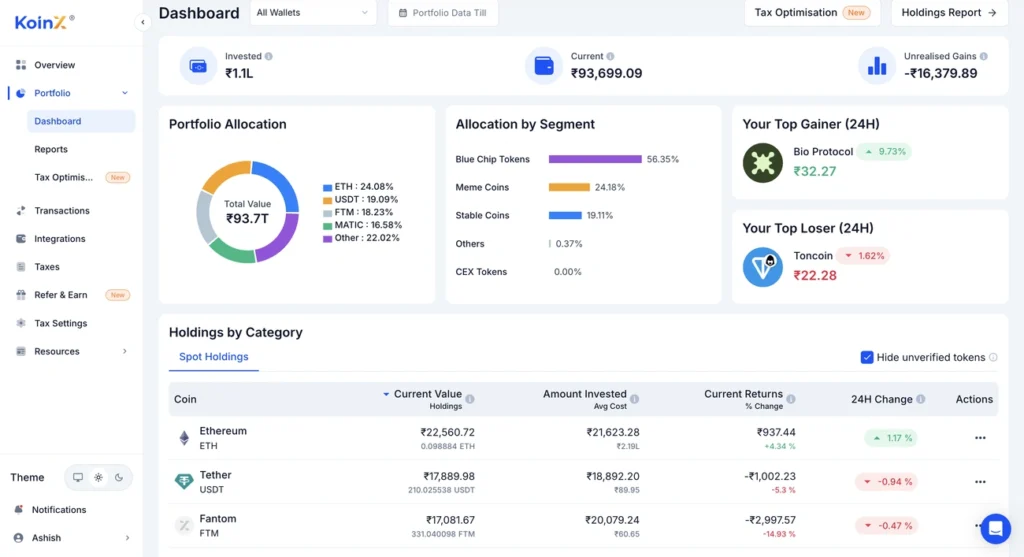
Image Source: KoinX
When and How to Rebalance Your Portfolio
Rebalancing prevents portfolio drift and enforces disciplined selling of winners to buy underperforming assets. Two methods exist: threshold-based rebalancing triggers when any asset deviates by a set percentage (15% threshold delivered 77.1% outperformance versus holding), while time-based rebalancing occurs quarterly or annually regardless of market conditions. Research shows yearly rebalancing generated 143% returns, quarterly produced 111%, and monthly yielded 97%. Monthly rebalancing creates the lowest volatility at 10.88 annualized standard deviation.
Tracking Performance Against Benchmarks
Use time-weighted return to measure crypto portfolio strategy effectiveness, removing cash flow impacts. Compare your TWR against benchmark indices to assess real performance. Sharpe ratios above 1.0 indicate good risk-adjusted returns, above 2.0 signals excellence. A 5% crypto allocation historically doubled annualized returns from 4.8% to 8.2-9.4% while broader crypto exposure achieved Sharpe ratios up to 0.75.
Using Stablecoins for Liquidity Management
Stablecoins enable real-time liquidity management impossible with traditional banking. Treasury teams consolidate cash positions across subsidiaries without waiting for cut-off times, reducing settlement from weeks to hours. Diversify stablecoin holdings across USDC, USDT, and PYUSD to reduce single-issuer risk while maintaining fiat liquidity buffers.
Common Portfolio Management Mistakes to Avoid
Limit crypto to 5-10% of total portfolio allocation. Avoid chasing quick gains driven by FOMO, as impulsive decisions lead to buying high and selling low. Track after-fee, after-tax returns since fees consume 1-2% annually and taxes reduce gains further.
Advanced Crypto Portfolio Strategies for 2026
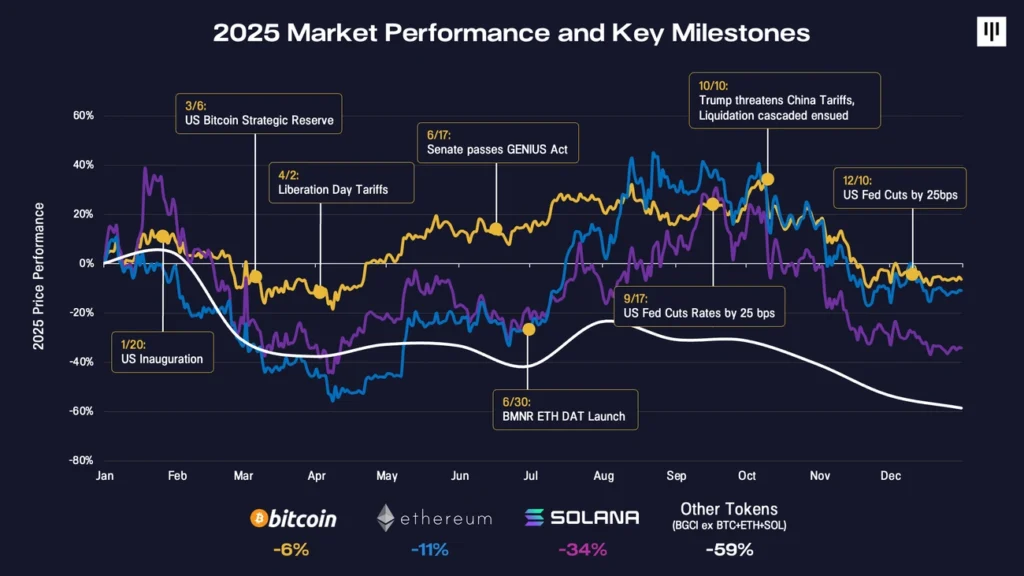
Image Source: Pantera Capital
Sector Rotation and Thematic Tilts
Capital flows through crypto markets in predictable sequences during bull cycles. Smart money accumulates Bitcoin first, then Ethereum outperforms as the ETH/BTC ratio rises, followed by alternative Layer-1 platforms, DeFi protocols, and finally memecoins during peak retail FOMO. Harvard Management Company demonstrated this rotation in practice by selling $72 million in Bitcoin ETF holdings and deploying $86.8 million into Ethereum ETFs, effectively rotating from a macro store-of-value narrative into growth-layer infrastructure. The Altcoin Season Index provides quantifiable rotation signals: readings below 25 indicate Bitcoin dominance, 25-75 marks transition phases, and above 75 signals full altseason. Currently at 57, the market sits in an optimal entry window for altcoin rotation.
Portfolio Hedging with Derivatives
Derivatives create offsetting positions that lock portfolio value regardless of price direction. Selling short 35,000 derivatives contracts (each with $1 contract size) against 1 Bitcoin at $35,000 perfectly hedges price risk. Delta-neutral hedging maintains portfolio delta near zero through continuous rebalancing, while partial hedging preserves upside exposure by covering only 50% of holdings. Institutions also deploy proxy hedging, using Bitcoin or Ethereum futures to hedge correlated altcoin baskets based on stable correlation patterns.
Geographic and Regulatory Diversification
Regulatory fragmentation across jurisdictions creates both risk and opportunity. Europe’s MiCA framework provides legal certainty for issuance and custody, while the U.S. GENIUS Act establishes federal standards for stablecoin issuers by July 2026. Singapore’s MAS licensing, Dubai’s VARA framework, and Switzerland’s DAO-friendly precedents offer alternative incorporation venues that mitigate single-jurisdiction regulatory shocks. Crypto projects headquartered outside the U.S. now represent over 70% of market capitalization, up from 60% in 2022.
Conclusion
You now have the complete framework to build and manage a winning crypto portfolio for 2026. The fundamentals are clear: start with a core-satellite structure, allocate based on your risk tolerance, and diversify across categories rather than chasing individual coins.
Most important, remember that portfolio allocation drives your returns far more than timing or picking the perfect altcoin. Rebalance consistently, track your performance against benchmarks, and avoid the common mistakes that derail even experienced investors.
Start with the basics, implement what resonates with your goals, and refine your crypto portfolio strategy as you gain experience. The market rewards discipline over speculation.
FAQs
Q1. Will 2026 be a favorable year for cryptocurrency investments? While crypto markets experienced volatility at the end of 2025, several positive trends suggest 2026 could favor bullish momentum. Institutional adoption continues to grow, with over 75% of professional investors planning to increase crypto allocations. Regulatory clarity across major markets is improving, and the fundamental infrastructure supporting digital assets remains strong. These factors create a supportive environment for long-term crypto portfolio growth.
Q2. What is the 1% rule in cryptocurrency investing? The 1% rule is a risk management principle that limits your exposure on any single trade to 1% of your total portfolio capital. More conservative investors follow a 1-2% risk threshold per position. This approach protects your overall portfolio from catastrophic losses on individual trades and ensures you can withstand multiple losing positions without depleting your capital.
Q3. Which cryptocurrencies should I consider for my 2026 portfolio? A balanced portfolio typically includes Bitcoin (60-80% allocation) as the core holding due to its lower volatility and institutional infrastructure, Ethereum (15-25%) for smart contract exposure, and selective altcoins (5-10%) as satellite positions. For diversification, consider spreading satellite holdings across different sectors including Layer-1 protocols like Solana or Avalanche, DeFi tokens, and infrastructure projects across various market capitalizations.
Q4. How often should I rebalance my crypto portfolio? Research shows that yearly rebalancing generated 143% returns, while quarterly produced 111% and monthly yielded 97%. Monthly rebalancing creates the lowest volatility but requires more active management. A threshold-based approach that triggers rebalancing when any asset deviates by 15% from target allocation has historically delivered strong outperformance while reducing unnecessary trading.
Q5. What percentage of my total investment portfolio should be in cryptocurrency? Financial advisors typically recommend limiting crypto to 5-10% of your total portfolio allocation. This percentage provides meaningful exposure to crypto’s growth potential while protecting your overall wealth from the asset class’s high volatility. Before investing, ensure you have 6-12 months of salary saved in an emergency fund and understand your ability to tolerate significant portfolio drawdowns.
People Also Read: What Are Anime Terms? Essential Japanese Words for Fans