
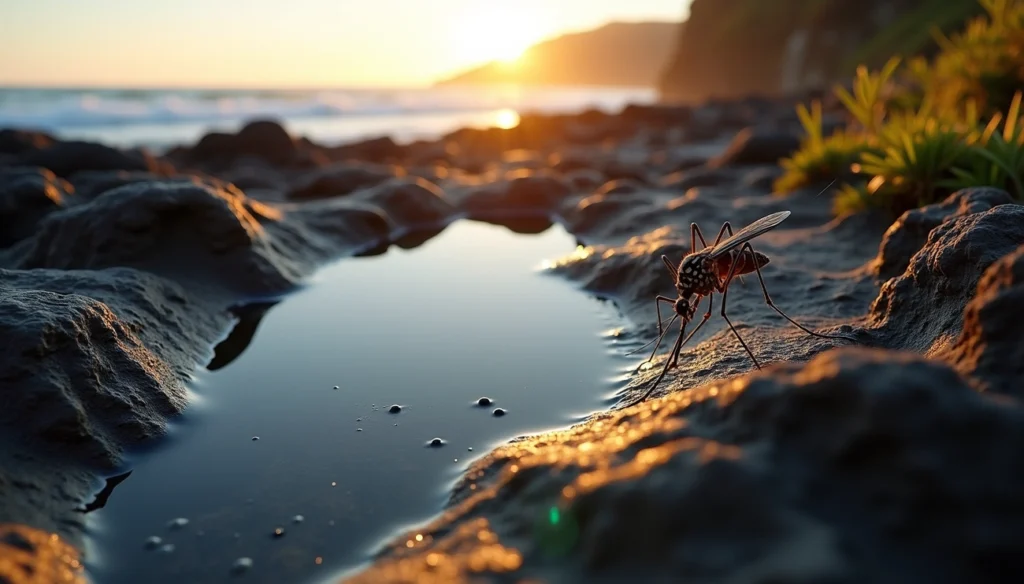

The Aedes australis mosquito first appeared in New Zealand in 1961, when it was discovered in a boat hull at Stewart Island. Since then, this unique brackish water species has established itself exclusively in the southern half of the South Island. Unlike many common mosquitoes, this particular species displays fascinating ecological constraints that limit its habitat strictly to coastal environments.
Interestingly, as one of only three established exotic Aedes mosquito species in New Zealand, the Aedes australis has specific breeding requirements that dictate its distribution. These mosquitoes breed exclusively in littoral rock and brackish pools just above the tide line and generally remain close to these breeding habitats [-2]. Additionally, the percentage of autogenous females can fluctuate dramatically with the seasons, ranging from 40% in summer months to 85% in winter due to temperature variations. While spreading to regions including Southland, Westland, and as far north as Timaru, this species has even begun to out-compete the native Opifex fuscus (saltpool mosquito) in some southern locations.
In this article, we’ll explore why the Aedes australis mosquito thrives only in New Zealand’s coastal areas, examining its unique adaptations, breeding constraints, and ecological impact on local mosquito populations.
Taxonomic Identity and Origin of Aedes australis
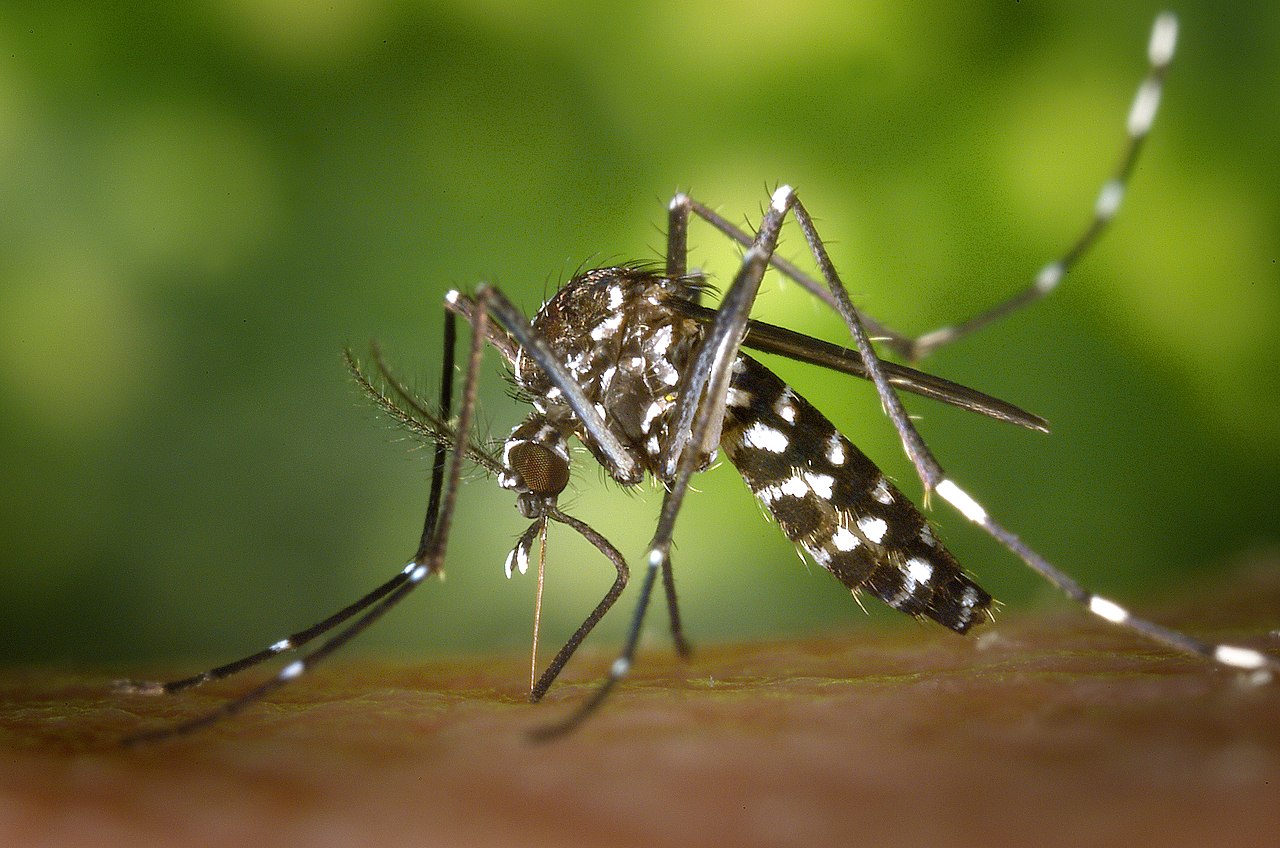
Image Source: Wikipedia
Taxonomically speaking, Aedes australis belongs to the diverse mosquito genus Aedes, which comprises over 950 known species distributed worldwide except Antarctica. This coastal-dwelling mosquito holds a specific position within the hierarchical classification system of arthropods. Formally, it falls under the kingdom Animalia, phylum Arthropoda, class Insecta, order Diptera, family Culicidae, and genus Aedes.
Classification within Aedes mosquito species
Aedes australis represents one of the many specialized subgenera within the larger Aedes genus. Notably, it belongs to the subgenus Halaedes[33], which distinguishes it from other Aedes mosquitoes. The scientific binomial name, Aedes australis (Erichson, 1842), reflects both its genus and species designation. Unlike many of its relatives, this particular species has adapted specifically to brackish water environments, making it ecologically distinct within its taxonomic group.
Aedes australis vs Aedes aegypti and Aedes atlanticus
In contrast to its more infamous relatives, Aedes australis maintains a limited geographic distribution. The yellow fever mosquito (Aedes aegypti) serves as a known vector for several serious diseases including yellow fever, dengue, chikungunya, and Zika viruses. Furthermore, Aedes aegypti has historically expanded its range through international travel and trade, having previously established itself throughout Mediterranean countries before experiencing a reduction in distribution. Similarly, Aedes atlanticus, another species within the genus, has different ecological requirements and distribution patterns.
Aedes australis, however, demonstrates more constrained habitat preferences compared to these counterparts. Although not typically considered a major disease vector in New Zealand, it has been identified as a minor vector of Ross River virus in Tasmania.
Aedes mosquito origin and introduction to New Zealand
Originally native to Australia, Aedes australis made its way to New Zealand through human activity. The species first arrived on timber ships from Australia, with initial documentation occurring in 1961 when it was discovered in a boat hull at Stewart Island. Subsequently, authorities confirmed its presence in 1962 on mainland New Zealand at ports in Bluff and Dunedin.
Following this introduction, the mosquito established itself permanently across the southern half of South Island. Over time, it has expanded its territory to encompass Southland, Westland, and reached as far north as Timaru, demonstrating its ability to adapt to New Zealand’s southern coastal environments despite its specialized habitat requirements.
Breeding Habitat Constraints in Coastal Environments
Unlike many other mosquito species that inhabit freshwater environments, the Aedes australis mosquito exhibits highly specialized breeding habitat requirements. These constraints largely explain its limited geographic distribution across New Zealand’s southern coastal regions.
Dependence on brackish rock pools above tide line
Aedes australis demonstrates a remarkable ecological specificity, breeding exclusively in littoral rock and brackish pools positioned just above the tide line. This habitat preference represents a distinctive adaptation among mosquito species. Consequently, adult populations of these mosquitoes remain tightly clustered around their breeding sites, seldom venturing far inland. The eggs are typically laid singly in coastal rock pools situated above the high-tide mark, ensuring they receive occasional salt water influx without being completely submerged during normal tidal cycles.
Egg morphology: Rhomboidal structure and salinity tolerance
The eggs of Aedes australis possess a distinctive rhomboidal structure when viewed from both ventral and dorsal perspectives. This unique morphology likely contributes to their ability to withstand brackish water conditions. Indeed, throughout the mosquito family, egg structure often correlates with environmental adaptations. Certainly, this specialized egg shape represents an evolutionary response to the challenging osmotic conditions present in coastal rock pools.
Limited inland breeding due to freshwater incompatibility
Primarily, the absence of Aedes australis in inland areas stems from its inability to thrive in freshwater environments. Research indicates that various Aedes species demonstrate differing responses to salinity. For instance, Aedes aegypti typically prefers freshwater for oviposition, whereas Aedes australis requires brackish water. Laboratory studies with other Aedes species show that populations derived from brackish water develop greater tolerance to salinity. Moreover, eggs from freshwater-derived Aedes aegypti hatch less efficiently in brackish water. Therefore, the physiological constraints regarding salinity tolerance effectively restrict Aedes australis to coastal zones, as inland freshwater bodies lack the salinity levels necessary for successful breeding and larval development.
Read other Articles – Capocollo, the Cut That Defines Italian Cured Meat
Autogeny and Temperature-Driven Reproduction Patterns

Image Source: CDC
One fascinating characteristic of Aedes australis is its variable reproductive strategy. Autogeny—the ability to lay eggs without a blood meal—sets this mosquito apart from many of its relatives.
Autogenous vs anautogenous populations in NZ and Australia
Reproductive patterns of Aedes australis vary by location. In most New Zealand regions, females are predominantly autogenous, laying their first batch of eggs without requiring a blood meal. This contrasts sharply with populations in Tasmania and South Australia, which are primarily anautogenous (requiring blood to reproduce). Even within New Zealand itself, populations in eastern regions are almost exclusively anautogenous, illustrating remarkable geographic variation in this trait.
Seasonal variation: 40% autogeny in summer vs 85% in winter
The expression of autogeny fluctuates dramatically with seasonal changes. Within the same breeding pool, autogenous females constitute merely 40% of the population during summer months yet increase to 85% in winter. This seasonal shift occurs primarily because cooler temperatures favor autogenous egg development, especially when combined with protein-rich larval diets.
Temperature influence on larval development and egg-laying
Temperature significantly impacts both development and reproduction. Studies on related Aedes species reveal that females reared at 28°C laid approximately 50 times more autogenous eggs than those at 22°C. Interestingly, lower temperatures actually produce larger adults due to extended development periods—13 days at 22°C versus 8 days at 28°C. These temperature-driven adaptations allow Aedes australis to maintain reproductive success across changing seasonal conditions.
Geographic Spread and Competitive Displacement
Currently, the Aedes australis mosquito occupies a highly specific geographic niche within New Zealand.
Restricted distribution in southern South Island
First documented in 1961, Aedes australis remains exclusively confined to the southern half of South Island. As of 2019, it exists as one of only three long-established exotic mosquito species in the country. Its distribution stands in stark contrast to Aedes notoscriptus and Culex quinquefasciatus, which have spread more extensively throughout both North and South Islands.
Competition with native Opifex fuscus in coastal zones
In Otago’s coastal environments, Aedes australis actively competes with the native Opifex fuscus mosquito. Principally, this competition has resulted in measurably smaller O. fuscus populations in these regions. According to research, larvae of O. fuscus are “heavily out-numbered by A. australis” in shared breeding pools. This competitive displacement suggests that if Aedes australis continues expanding its range, further reductions in native O. fuscus populations may occur throughout New Zealand’s coastal zones.
Absence in inland regions due to ecological limitations
The mosquito’s absence from inland areas stems directly from its specialized breeding requirements. As New Zealand has undergone extensive landscape transformation—with over 60% of land converted to farms, exotic forests, settlements, and roads—these changes have typically favored exotic mosquitoes while negatively impacting native species. Hence, Aedes australis remains tethered to coastal habitats where its required brackish breeding pools exist.
Conclusion
The Aedes australis mosquito stands as a testament to evolutionary specialization within New Zealand’s ecosystem. This unique brackish water species demonstrates remarkable adaptations that consequently restrict its habitat exclusively to coastal environments. Its rhomboidal eggs thrive specifically in littoral rock pools above the tide line, while simultaneously failing to develop in freshwater conditions found inland. Such specialization explains why, despite being present in New Zealand for over six decades, Aedes australis remains confined to the southern half of South Island.
Temperature plays a crucial role in this mosquito’s survival strategy. The dramatic seasonal shift in autogeny—from 40% in summer months to 85% in winter—reflects a sophisticated reproductive adaptation to New Zealand’s coastal climate. This ability to produce eggs without blood meals during colder periods undoubtedly contributes to the species’ persistence despite seasonal challenges.
Competition between Aedes australis and the native Opifex fuscus highlights significant ecological implications. The introduced species has begun outcompeting the native saltpool mosquito across southern coastal zones, thus altering the composition of local mosquito populations. This competitive displacement serves as a reminder that even highly specialized invasive species can disrupt native ecosystems.
The story of Aedes australis ultimately illustrates how specific biological constraints shape geographic distribution. Though first appearing in New Zealand through human activity in 1961, the mosquito’s specialized breeding requirements have naturally limited its spread. These strict ecological boundaries will likely continue defining where this species can survive, regardless of climate change or human landscape alterations throughout New Zealand.
FAQs
Q1. Are Aedes australis mosquitoes found throughout New Zealand? No, Aedes australis mosquitoes are found exclusively in the southern half of New Zealand’s South Island, primarily in coastal areas. They were first documented in 1961 and have since established themselves in specific regions like Southland, Westland, and as far north as Timaru.
Q2. Why are Aedes australis mosquitoes limited to coastal areas? Aedes australis mosquitoes are restricted to coastal areas due to their specialized breeding requirements. They breed exclusively in brackish rock pools just above the tide line, which are not found inland. Their eggs are adapted to tolerate the salinity in these coastal habitats but cannot survive in freshwater environments.
Q3. How does temperature affect Aedes australis reproduction? Temperature significantly influences Aedes australis reproduction. In summer, about 40% of females are autogenous (can lay eggs without a blood meal), while in winter, this increases to 85%. Cooler temperatures favor autogenous egg development, especially when combined with protein-rich larval diets.
Q4. Is Aedes australis competing with native mosquito species? Yes, Aedes australis actively competes with the native Opifex fuscus mosquito in coastal environments, particularly in Otago. This competition has resulted in smaller O. fuscus populations in these regions, with A. australis larvae often outnumbering the native species in shared breeding pools.
Q5. Can Aedes australis transmit diseases to humans? While Aedes australis is not considered a major disease vector in New Zealand, it has been identified as a minor vector of Ross River virus in Tasmania. However, its limited distribution and specific habitat requirements reduce its potential impact on human health compared to more widespread mosquito species.
Interested in similar content or opportunities. Contact Us