
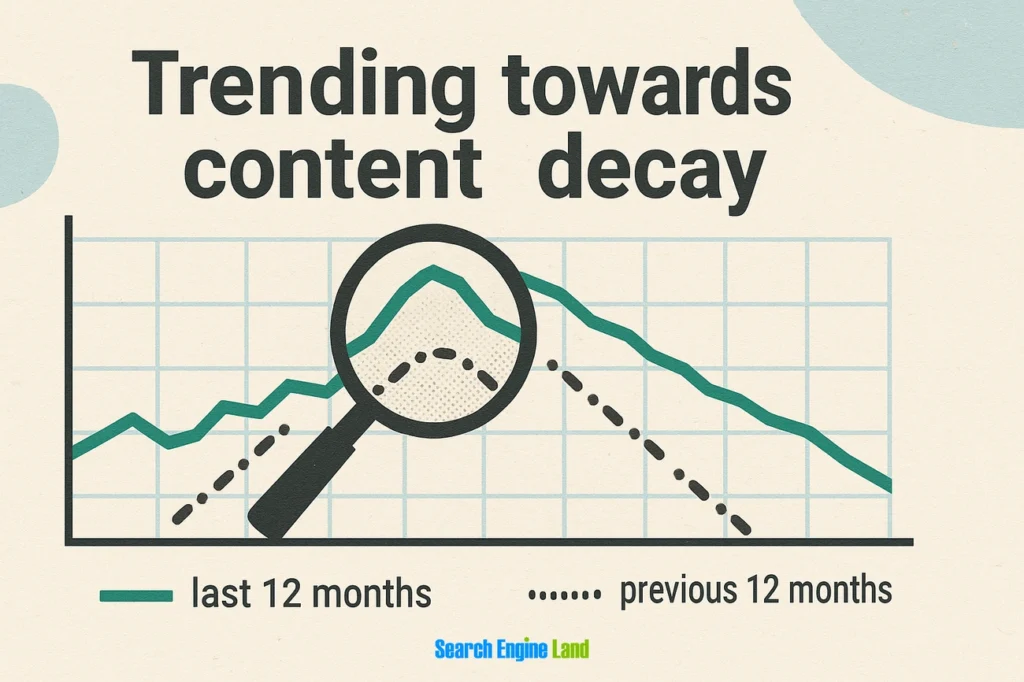

What is Content Decay?

Image Source: Search Engine Land
Content decay is the gradual decline in organic traffic and rankings for a specific webpage or blog post over time. Unlike sudden drops caused by Google penalties or technical errors, content decay occurs slowly over months as part of content’s natural aging process. This phenomenon affects all content types, including evergreen articles, case studies, blog posts, landing pages, and even multimedia content.
Research indicates the severity of this issue, with 90.63% of content receiving no traffic from Google at all. Furthermore, websites that neglect to optimize aging content could lose up to 20% of their organic traffic annually.
Content decay typically manifests through decreasing search visibility, declining engagement metrics, and reduced conversions. The primary factors driving this decline include:
- The Freshness Factor – Search intent changes over time, with Google prioritizing fresh content containing the latest information, statistics, and trends.
- Competitor Velocity – While existing content remains static, competitors publish newer, more comprehensive material targeting the same keywords, gradually pushing older content down in rankings.
- Decreased Relevance – Aging content contains outdated examples, screenshots, and data, creating poor user experiences and higher bounce rates that signal declining quality to search engines.
- Algorithm Shifts – Search engines regularly update evaluation criteria, meaning content that once ranked well may no longer meet current quality standards.
For large websites with hundreds or thousands of pages, content decay can have a compounding effect. Once organic traffic begins to drop, recovery may take months or even years. According to Gartner, search query volume is predicted to drop by 25% by 2026 as users increasingly turn to AI assistants and conversational platforms.
While content decay occurs naturally in the digital ecosystem, identifying and addressing it promptly remains crucial for maintaining visibility and preventing the erosion of overall site authority and revenue.
Why Does Content Decay Happen?

Image Source: Dreamstime.com
Content decay occurs naturally as part of the digital content lifecycle and stems from multiple factors that diminish relevance over time. Primarily, outdated information erodes credibility as industries evolve and new data emerges. For instance, statistics from past years or screenshots of outdated interfaces significantly reduce user engagement.
Link rot constitutes another major cause when external links break as referenced websites change or remove pages. Additionally, search engines constantly update their algorithms—with Google launching 4,725 changes to its search systems in 2022 alone—affecting how content is evaluated and ranked.
User behavior shifts represent a critical factor. As Gartner predicts, search query volume will drop by 25% by 2026 as more users turn to AI assistants. Moreover, search intent changes over time; what users sought two years ago differs from today’s queries. For example, searches for “electric vehicles” shifted from educational to transactional intent between 2000 and present day.
Competitor activity also drives decay. While existing content remains static, competitors continuously publish newer, more comprehensive material targeting identical keywords. Internal competition further compounds this issue through keyword cannibalization, where multiple pages on the same site compete for identical search terms.
Seasonal fluctuations affect traffic patterns as well. Many websites experience cyclical trends with predictable rises and falls depending on the time of year. These natural variations should not be confused with permanent decay.
The presence of evolving search features, including shopping results and featured snippets, diverts traffic from traditional organic listings. Consequently, even well-crafted content requires ongoing attention to maintain relevance and ranking position.
Read other Articles – Is Your Website Stuck in the Google Sandbox? Here’s What Works
How to Identify Content Decay

Image Source: HubSpot Blog
Monitoring website performance metrics reveals the telltale signs of content decay. Effective identification requires consistent tracking of several key indicators that signal when content needs refreshing.
1. Drop in organic traffic
Identifying content decay begins with recognizing a gradual, persistent downward slope in organic traffic patterns. Unlike sudden traffic drops from algorithm updates, content decay typically manifests as a gentle but consistent decline over several weeks or months. When analyzing traffic patterns, compare year-over-year data rather than month-over-month to account for seasonal variations.
2. Lower keyword rankings
A decaying page often shows declining average position for target keywords. This pattern appears as impressions trending downward while average position gradually drifts lower. Content that previously ranked in positions 1-5 and now sits at position 15 clearly demonstrates decay in action.
3. Decrease in engagement metrics
User behavior metrics provide critical insights into content performance. Higher bounce rates, lower time on page, decreased scroll depth, and reduced conversion rates all indicate diminishing content relevance. Notably, these engagement declines often precede more visible SEO losses.
4. Outdated or irrelevant information
Content referencing old statistics, outdated tools, or ineffective strategies quickly loses user trust. Pages containing examples, screenshots, or data that no longer apply create poor user experiences, particularly when competitors have published fresher information.
5. Competitor content outperforming yours
Thoroughly examine whether competitor content offers more current information, better formatting, or deeper topic coverage. When competitors address new subtopics, user objections, or utilize different formats like video that your content lacks, decay becomes increasingly likely.
Read other Articles – The Benefits of CRISPR That Medical Science Didn’t Tell You
How to Fix Content Decay
Fixing content decay demands a methodical approach focused on five key strategies.
1. Update outdated information
Regularly refreshing content keeps it relevant to readers and search engines alike. Best practice suggests updating website content every 3-6 months. Replace outdated statistics with current figures, revise obsolete facts, and incorporate recent developments in your field. This maintenance signals to search engines that your content remains fresh and valuable.
2. Improve SEO structure and formatting
Enhance readability by breaking up lengthy paragraphs, adding subheadings, and improving overall structure. Update title tags and meta descriptions to reflect any new content added. Restructure content into FAQ formats or listicles to optimize for featured snippets and position zero results. Ensure your site is mobile-friendly as this affects both user experience and rankings.
3. Add new keywords and examples
Reassess your target keywords and naturally integrate emerging terms throughout your content. Expand thin sections by adding new insights, case studies, or examples that demonstrate concepts more effectively. Quarterly SERP checks for high-priority keywords help identify shifting search patterns.
4. Align with current search intent
Search intent evolves as user behavior and expectations change. Examine top-ranking results to understand what content format now dominates. Metrics like bounce rate, time on page, conversion rate, and SERP CTR confirm whether your content matches what searchers want. Lead with direct answers to common questions and simplify complex sections.
5. Fix broken links and media
Broken links damage user experience and SEO performance. Prioritize fixing links on high-traffic pages first. For internal links, correct URL errors, restore deleted pages when possible, or set up 301 redirects. For external links, find similar replacement content or remove the link entirely. Use tools like Google Search Console to identify broken links across your site.
Conclusion
Addressing content decay requires a strategic approach based on regular monitoring combined with timely updates. Detecting early signs of decay through analytics tools such as Google Search Console, Ubersuggest, or SEMRush enables prompt intervention before traffic losses become significant. Upon identifying declining content, implementing targeted refreshes yields substantial benefits compared to starting from scratch.
Fixing decaying content represents one of the highest-ROI activities in SEO. The process demands fewer resources than creating entirely new material yet delivers comparable or superior results. This efficiency stems from building upon existing authority rather than establishing it anew.
Content should be viewed as a living digital asset requiring regular maintenance. Much like physical property, neglected content deteriorates over time, whereas properly maintained pages retain or increase their value. Establishing a systematic review schedule—quarterly for cornerstone content, biannually for standard pages—prevents unexpected traffic declines.
A balanced content strategy incorporates both creation and preservation elements. This dual approach maintains site freshness while protecting established traffic sources. Through proactive content management, websites demonstrate continued relevance to search engines, strengthening overall domain authority.
FAQs
Q1. What is content decay and why does it happen? Content decay refers to the gradual decline in organic traffic and rankings for a webpage over time. It occurs due to factors like outdated information, changing search intent, competitor activity, and evolving search engine algorithms. As content ages, it may become less relevant or valuable to users, leading to decreased performance in search results.
Q2. How can I identify content decay on my website? You can identify content decay by monitoring key indicators such as a consistent drop in organic traffic, lower keyword rankings, decreased engagement metrics (like higher bounce rates and lower time on page), outdated information, and competitor content outperforming yours. Regular analysis of these factors can help you spot decaying content early.
Q3. What are effective strategies to fix content decay? To fix content decay, focus on updating outdated information, improving SEO structure and formatting, adding new keywords and examples, aligning with current search intent, and fixing broken links and media. Regularly refreshing your content and ensuring it remains relevant and valuable to your audience is crucial for maintaining and improving search rankings.
Q4. How often should I update my website content to prevent decay? Best practices suggest updating website content every 3-6 months. However, the frequency may vary depending on your industry and the type of content. Cornerstone content may require quarterly reviews, while standard pages could be updated biannually. Regular monitoring of performance metrics can help determine when updates are necessary.
Q5. Is fixing decaying content more effective than creating new content? Fixing decaying content is often more efficient and can yield a higher ROI compared to creating entirely new content. It requires fewer resources while building upon existing authority. However, a balanced content strategy should incorporate both updating existing content and creating new material to maintain site freshness and protect established traffic sources.
Disclaimer
This article provides general guidance on content decay. Results may vary based on industry, competition, and search algorithm changes. We recommend consulting with an SEO professional for personalized advice.
Interested in similar content or opportunities. Contact Us