
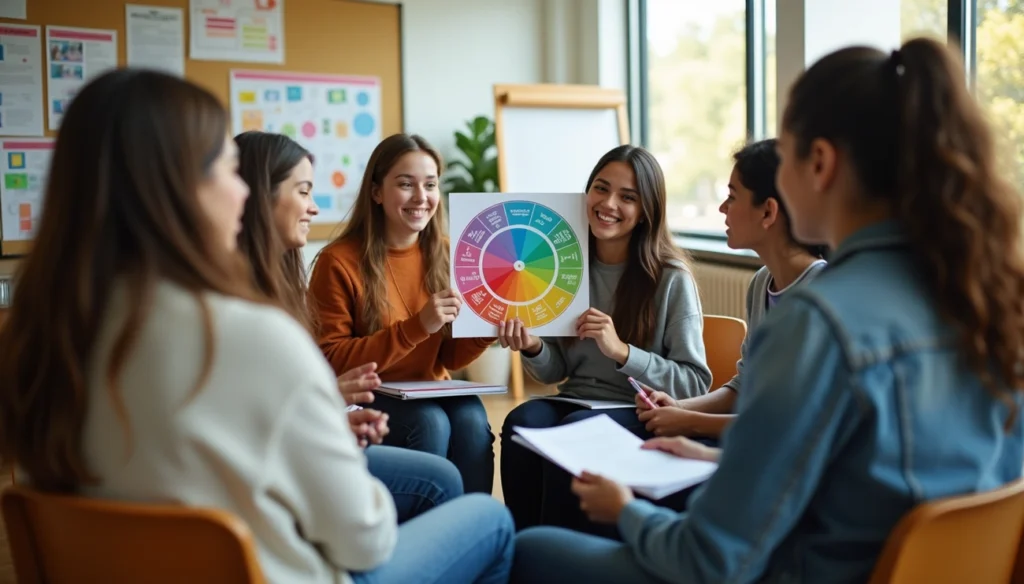

Did you know that students who participate in SEL activities show significant improvements in behavior, relationships, and academic achievement?
Today’s students face a troubling reality. According to Dr. Bruce Perry, a renowned psychiatrist and neuroscience researcher, kids now have fewer opportunities to develop social-emotional skills than they did 30 years ago. In fact, he notes that many college students today have “the empathic capabilities of children who are five or six years old.”
This is precisely why implementing social-emotional learning in the classroom has become essential. Schools like Summit Preparatory Charter High School in California are leading the way, dedicating 90-minute weekly classes specifically to developing these critical life skills. Furthermore, research demonstrates that SEL strategies in the classroom not only promote positive mental health and emotional well-being but also improve graduation rates and college attendance.
When we integrate SEL classroom activities effectively, we create opportunities for students to learn about, reflect on, and discuss important social-emotional competencies. Additionally, these SEL learning activities help students understand their feelings, empathize with others, and engage in positive interactions.
In this guide, we’ll explore practical, easy-to-implement SEL strategies that can transform your classroom environment and strengthen your connection with students. From emotional check-ins to creative tasks and reflection exercises, these activities will help you build a more supportive and engaged learning community.
Start with Emotional Check-Ins

Image Source: CM School Supply
Beginning your class with emotional check-ins creates a powerful foundation for social-emotional learning. These simple activities invite students to recognize their feelings, building crucial self-awareness while developing emotional vocabulary skills.
Use daily mood meters or emotion charts
Mood meters offer a visual approach for students to identify and communicate their emotional state. The Yale Center for Emotional Intelligence’s four-quadrant chart categorizes emotions by energy level and pleasantness – red (high-energy/unpleasant), yellow (high-energy/pleasant), blue (low-energy/unpleasant), and green (low-energy/pleasant). Implementation is straightforward:
- Display the mood meter in a prominent location
- Ask students to identify where their emotions fall on the chart
- For younger students, use a simplified version with basic emotions
- Allow students to share reasoning if comfortable
The act of placing oneself on the mood meter is essentially a mindful exercise—it forces students to pause, reflect, and assess their feelings in real-time. This self-reflection process helps students develop emotional awareness while providing you valuable insight into their well-being.
Try ‘name the feeling’ circle time
Circle time creates a safe space for emotional expression. During these gatherings, students practice identifying emotions through structured activities:
- “One Word” circles where each student shares a single word describing their current feeling
- Emotion cards with happy, sad, and angry faces where students act out feelings for classmates to guess
- “Pass the smile” activities where students practice facial expressions related to different emotions
Devoting at least one circle time lesson monthly to emotions helps young students develop critical emotional intelligence. These activities work particularly well with elementary students who are still developing their ability to think hypothetically.
Incorporate quick journaling prompts
Journaling allows students to process emotions privately while building self-awareness. Effective prompts include:
- “If your mood were weather, what would it be today?”
- “Rank your mood on a scale of 1-10”
- “Which emotion are you trying to avoid right now?”
- “What advice would you give a friend in your current situation?”
For younger students, consider adapting prompts to include drawing options or simplified language. Journaling provides a safe, consistent place for students to share about SEL topics important to them.
By incorporating these sel activities consistently, students develop greater emotional literacy. Consequently, they become better equipped to handle challenges, make informed choices, and build meaningful relationships—essential skills for both academic success and life beyond the classroom.
Read other Articles: How Leading Companies Cut Incident Rates Using Best EHS Software
Build Connection Through Group Activities
Group activities form the cornerstone of effective social-emotional learning, creating meaningful opportunities for students to practice skills with peers. Rather than focusing solely on individual reflection, these collaborative exercises foster genuine connections that transform classroom dynamics.
Use identity-based icebreakers
Identity-based activities help students recognize both their uniqueness and their connections to others. Using identity charts, students explore factors that shape their own identity alongside those of groups, nations, and historical figures. This promotes self-awareness while developing respect for different perspectives.
For multicultural classrooms, consider implementing the “#Ricebreaker” activity where students share how their family or culture cooks rice. Through this simple discussion, students discover how they hold different perspectives based on their own experiences—modeling intellectual respect throughout the semester.
Name stories offer another powerful approach. Students share the history behind their first name, middle name, nickname, or another meaningful name, exploring its significance and origin. This exercise validates each student’s background while building classroom community.
Facilitate empathy-building games
Empathy-building activities help students understand others’ emotional experiences. Role-playing stands out as particularly effective—students can:
- Write short stories from a character’s perspective
- Act out scenes from novels or historical events
- Dress as favorite characters and explain their challenges
For younger students, emotion charades helps develop emotional literacy fundamentals. One student acts out an emotion while others guess what they’re portraying. Moreover, “I Spy Feelings” asks students to observe and name emotions they see in others, using sophisticated emotional vocabulary to strengthen empathetic muscles.
Try ‘Appreciation, Apology, Aha’ circles
The “Appreciation, Apology, Aha” routine creates a powerful framework for nurturing classroom community. Students gather in a circle to share one of three things:
- An appreciation for a classmate
- An apology for something they regret
- An “aha” moment of understanding
Begin by modeling your own reflection first, thereafter using a wraparound strategy so each student has an opportunity to share. For online classes, students can respond in chat or through platforms like Padlet or Flipgrid.
This activity promotes authentic connection by encouraging students to express gratitude, take responsibility, and acknowledge learning moments. Indeed, as one 12th-grade student noted, “When you pay attention to each other, not only does it build community, but we’re more able to understand other people”.
Encourage Self-Awareness with Creative Tasks
Creative tasks offer students powerful avenues for self-discovery and emotional growth. Through artistic expression, they develop deeper understanding of themselves and others, building essential social-emotional competencies in engaging ways.
Create personal vision boards
Vision boards serve as visual roadmaps of students’ aspirations and goals. Beyond simple collages, these powerful educational tools positively influence cognitive, emotional, and social development. Students create their vision boards by collecting images, quotes, words, and artwork that represent their dreams and aspirations.
To implement this activity effectively:
- Have students identify weekly, monthly, and bi-yearly targets
- Provide magazines, photographs, and decorations for physical boards
- Offer digital alternatives using PowerPoint, Canva, or similar platforms
- Encourage students to display their boards where they’ll see them daily
Vision boards primarily help students articulate their dreams while learning the importance of goal-setting. Furthermore, this process promotes introspection, helping them identify their likes, dislikes, strengths, and areas of interest.
Write poems from another’s perspective
Poetry offers a unique window into emotional expression and empathy development. By writing from different perspectives, students process difficult emotions and develop authentic self-expression.
Effective poetry prompts include:
- Choose emotions (content, anxious, joyful) and list times they’ve felt them
- Write from a character’s perspective to understand motivations
- Create “I Am” poems that celebrate uniqueness
- Connect words, similes, and metaphors to specific emotions
As students share and discuss their poems, they develop communication skills by learning to articulate thoughts and feelings effectively and respectfully. Generally, this activity helps students understand characters’ motivations, feelings, and conflicts, while relating these experiences to their own lives.
Use role-play to explore emotions
Role-playing provides safe opportunities for students to explore emotional responses to various scenarios. For this activity, students act out different situations and subsequently reflect on their performance.
Even though simple in concept, role-play offers profound benefits:
- Helps students practice social skills in safe spaces
- Enhances emotional awareness
- Builds healthy communication and problem-solving abilities
- Teaches conflict-resolution through simulated experiences
To implement, create scenario cards with prompts like “Your friend is being bullied” or “You are being scolded for something you haven’t done”. After students act out scenarios, facilitate discussions where classmates offer suggestions and appreciation in a non-judgmental environment.
For younger students, “Emotion Charades” works exceptionally well—they act out emotions without words, helping them understand facial expressions and body language.
Use SEL Classroom Activities to Reinforce Skills
Embedding SEL into everyday academic learning creates a powerful dual impact. Instead of treating social-emotional skills as separate from subject content, strategic integration reinforces both simultaneously, making learning more meaningful and effective.
Integrate SEL into academic subjects
Effective SEL implementation includes explicit instruction—dedicated time for students to learn about, reflect on, and discuss SEL competencies. Throughout various subjects, you can incorporate SEL naturally:
- ELA: Discuss character emotions and choices or assign SEL-themed writing prompts with reading assignments
- Math: Promote perseverance with problem-solving and team-based challenges
- Science: Set up different experiment stations where small groups collaborate to conduct experiments, record findings, and discuss results
- Social Studies: Explore cultural competence, fairness, and empathy through historical and current events
This integration helps transform students’ classroom experiences by putting them in charge as they tackle content, collaborate with peers, and communicate effectively.
Use collaborative projects to teach teamwork
Collaborative learning helps students develop higher-level thinking, communication, self-management, and leadership skills. For instance, the balloon toss activity teaches valuable teamwork lessons—students in small groups keep a balloon in the air for one minute without holding it. Between rounds, ask groups to discuss what worked and didn’t work, examining their communication strategies.
Similarly, marshmallow tower challenges where teams build structures using marshmallows and toothpicks promote problem-solving and cooperation. Throughout these activities, students learn compromise, patience, and the value of different perspectives.
Practice active listening in group discussions
Active listening fosters open communication and helps students understand different perspectives. One effective exercise involves pairing students where one speaks about something important to them for 3-4 minutes while their partner listens quietly. Afterward, the listener paraphrases what they heard in their own words.
Furthermore, “Listen Without Speaking Twice” reinforces restraint—until everyone has spoken once, no one is allowed to speak a second time. Such activities teach students to value every voice in the classroom while developing crucial listening skills that transfer to academic discussions.
Close with Reflection and Goal Setting
The final minutes of class offer prime opportunities to solidify SEL learning through structured reflection activities. These closing routines help students process their experiences, set intentions, and recognize progress—transforming classroom learning into lifelong skills.
End class with gratitude journaling
Gratitude practices create powerful shifts in student mindsets. Dedicating just five minutes daily for students to record things they’re thankful for yields remarkable benefits—higher grades, greater satisfaction with relationships, and increased willingness to give back.
To implement gratitude journaling effectively:
- Use composition books or digital files for students to record five gratitudes daily
- Create a “gratitude wall” with sticky notes of student appreciations
- Try the “Three Good Things” activity where students name and record positive daily moments
- Close each week with a gratitude circle where students share their favorite entries
For younger students, consider simplified prompts like “I’m thankful for…” or drawing options that make the concept accessible. Additionally, incorporating this practice helps students transition out of “academic mode” into a reflective mindset.
Set weekly personal or group goals
Goal setting teaches students self-regulation—controlling short-term actions to manifest future aspirations. Begin by explaining the SMART framework: specific, measurable, achievable, relevant, and time-bound goals.
Notably, students who participate in structured goal-setting show higher academic achievement and engagement. For weekly implementation, try a four-step GOAL journal approach:
- Express Gratitudes
- Set Objectives aligned with quarterly personal goals
- Write personal Affirmations (small wins)
- Record Lessons learned from mistakes
Support reflection with sentence starters such as “This week, I was successful in…” or “I struggled with…”. Throughout this process, encourage students to discover their “why”—their intrinsic motivation behind each goal.
Celebrate small wins and progress
Recognizing progress maintains motivation and builds self-confidence. Celebration doesn’t require elaborate ceremonies—simply acknowledging growth through certificates, shout-outs, or classroom displays can powerfully affect student persistence.
Ultimately, what makes SEL reflection meaningful isn’t grand gestures but consistent practice. Including explicit SEL instruction doesn’t require drastic changes—start with five minutes here and ten minutes there. These small investments lead to significant changes in students, classroom community, and ourselves.
Conclusion
Social-emotional learning stands as a cornerstone of modern education, equipping students with essential life skills beyond academic knowledge. Throughout this guide, we’ve explored practical SEL activities that foster student connections while developing critical competencies. These strategies require minimal preparation yet yield significant results for classroom dynamics and student development.
Emotional check-ins create foundations for self-awareness, allowing students to recognize and articulate feelings effectively. Group activities subsequently build upon this awareness, transforming individual understanding into meaningful peer connections. Creative tasks further deepen these relationships through artistic expression, helping students explore emotions in safe, engaging ways.
Additionally, integrating SEL into academic subjects reinforces both content knowledge and social-emotional skills simultaneously. Rather than treating SEL as separate from curriculum, this dual approach enhances learning outcomes across all areas. Most importantly, consistent reflection practices help students internalize these skills, making them lifelong habits rather than classroom-only exercises.
You might feel overwhelmed by the prospect of implementing all these activities at once. Start small instead—perhaps with a simple mood meter or gratitude practice—then gradually expand as both you and your students become comfortable with the process. The key lies not in perfection but consistency, allowing these practices to become natural parts of your classroom routine.
Remember, SEL benefits extend far beyond immediate classroom management. Students who develop these competencies show improved academic performance, better relationships, and greater emotional resilience. They carry these skills into adulthood, where they continue to serve as foundations for personal and professional success.
Ultimately, investing time in social-emotional learning pays dividends for both students and teachers alike. While academic content may fade, the ability to understand emotions, build connections, and navigate social situations lasts a lifetime.
Disclaimer: The activities described in this article serve as suggestions only. Teachers should adapt these approaches based on their specific classroom needs, student ages, and school policies. Some activities may require modification for students with different learning styles or specific emotional needs.
FAQs
Q1. How can I incorporate SEL activities into my daily classroom routine? Start with simple activities like daily emotional check-ins using mood meters or quick journaling prompts. Gradually integrate SEL into academic subjects and end each class with reflection exercises. Consistency is key, even if you begin with just 5-10 minutes per day.
Q2. What are some effective group activities for building student connections? Try identity-based icebreakers like sharing name stories, empathy-building games such as emotion charades, and “Appreciation, Apology, Aha” circles. These activities help students understand different perspectives and foster a sense of community in the classroom.
Q3. How can creative tasks enhance students’ self-awareness? Creative tasks like personal vision boards, perspective-based poetry writing, and role-playing exercises allow students to explore emotions and develop self-expression in engaging ways. These activities help students better understand themselves and others.
Q4. What are some ways to integrate SEL into academic subjects? Incorporate SEL naturally by discussing character emotions in literature, promoting perseverance in math problem-solving, or exploring cultural competence in social studies. Use collaborative projects to teach teamwork and practice active listening during group discussions across all subjects.
Q5. Why is reflection important in SEL, and how can it be implemented? Reflection helps solidify SEL learning and turns classroom experiences into lifelong skills. Implement it through gratitude journaling at the end of class, setting weekly personal or group goals, and celebrating small wins. These practices help students process their experiences and recognize their progress.
Disclaimer
While these SEL activities offer valuable frameworks for classroom implementation, every educational environment presents unique characteristics. The suggestions provided should be adapted to suit your specific student population, classroom dynamics, and institutional policies.
Before introducing new emotional learning techniques, consider consulting with school counselors or mental health professionals, especially for activities addressing sensitive topics or potentially triggering scenarios. Although these activities have proven beneficial across various settings, outcomes may vary depending on implementation.
Always respect student privacy throughout emotional check-ins and journaling exercises. Establish clear boundaries regarding what information students must share versus what remains private. Unless mandatory reporting situations arise, honor confidentiality within appropriate educational parameters.
Recognize cultural differences in emotional expression and social interaction—what works effectively in one community might require significant modification in another. Consequently, adapt activities to respect diverse cultural backgrounds represented in your classroom.
Parents should be informed about SEL curriculum components, particularly for younger students. Maintain regular communication regarding emotional learning objectives and outcomes.
Regardless of how carefully planned, some students may require additional support beyond classroom SEL activities. Develop appropriate referral protocols for students needing specialized assistance from qualified mental health professionals.