
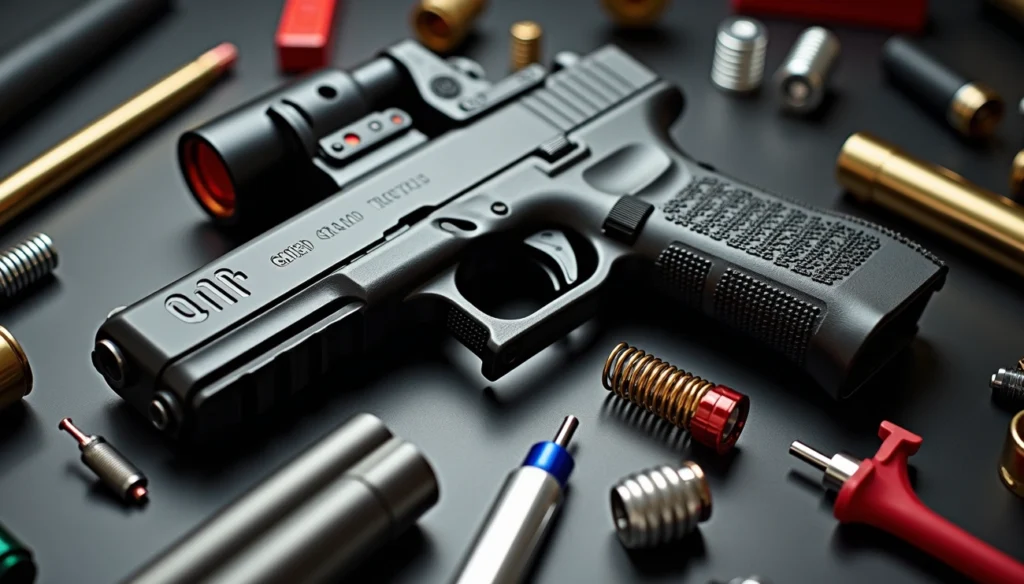

Your competition Glock straight from the factory will get you through a match, but it won’t get you on the podium. Winning requires strategic upgrades that enhance speed, accuracy, and control.
We’ve compiled 13 essential modifications that transform stock Glocks into match-winning machines. From the competition glock trigger and competition glock sights to compensators that reduce recoil by as much as 50%, each upgrade serves a specific purpose. Whether you’re running a glock 34 competition setup or building out a competition glock 19, these enhancements will give you the competitive edge you need.
Competition Glock Trigger Upgrade
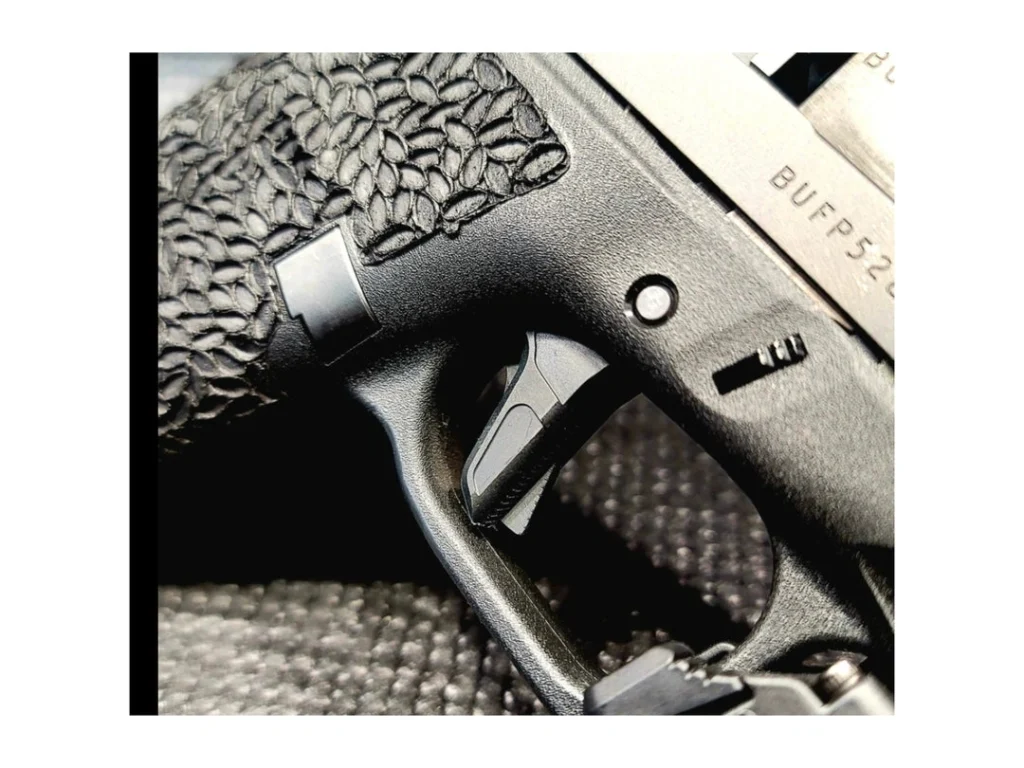
Why Trigger Matters in Competition
Stock Glock triggers average 5.5 to 6 pounds with a mushy, gritty pull that lacks precision. Upgrading the trigger system addresses the single biggest limitation in factory Glocks, delivering shorter reset distances, crisp breaks, and lighter pull weights that translate directly to faster split times.
A quality competition glock trigger reduces pre-travel by approximately 30% and provides tactile feedback that builds muscle memory. The reset distance matters more than most shooters realize. Shorter reset means you return to the break point faster between shots, hence improving your ability to maintain sight alignment during rapid strings.
Best Competition Glock Trigger Options
The Timney Alpha Competition stands as the gold standard for serious competitors. With a factory pull weight of 3 pounds and NP3-coated trigger bar and sear, it fired 10,000 rounds with no oiling, no cleaning, and zero malfunctions. The glass-crisp break and extremely short reset make it ideal for rapid-fire stages.
The Glock Performance Trigger offers a factory-backed alternative. Field testing averaged 4.1 pounds with short take-up, solid wall, and clean break without detectable creep. At $115.50 shipped from Glock, it maintains all Safe Action safety features while operating from a fully cocked striker.
For budget-conscious shooters, the Ghost 3.5 lb Connector provides a single-component upgrade that reduces pull weight and delivers smoother, more consistent feel without overhauling the entire system.
The Zev Pro Series Ultimate Kit measures 3.8 pounds with minimal variation and approximately 30% reduced pre-travel from stock. Installation requires 60-90 minutes with careful attention to spring orientation.
Installation and Break-In Tips
Installation complexity varies from simple connector swaps to complete trigger assemblies requiring careful function testing. The Timney Alpha includes silver and red springs for adjustable pull tension, with installation possible at home or through Timney for $40 plus $35 shipping.
Break-in typically occurs between 500 and 2,000 rounds. Polishing contact points accelerates this process, simulating hundreds of rounds of wear. Regular cleaning of the firing pin assembly prevents heavy or sticky trigger pull.
Expected Performance Improvements
Upgraded triggers deliver measurably tighter groups and improved shot placement. Some systems promise a 70% decrease in reset distance, while crisp breaks eliminate the jerking motion caused by fighting through heavy factory pulls.
Red Dot Optics and Mounting System
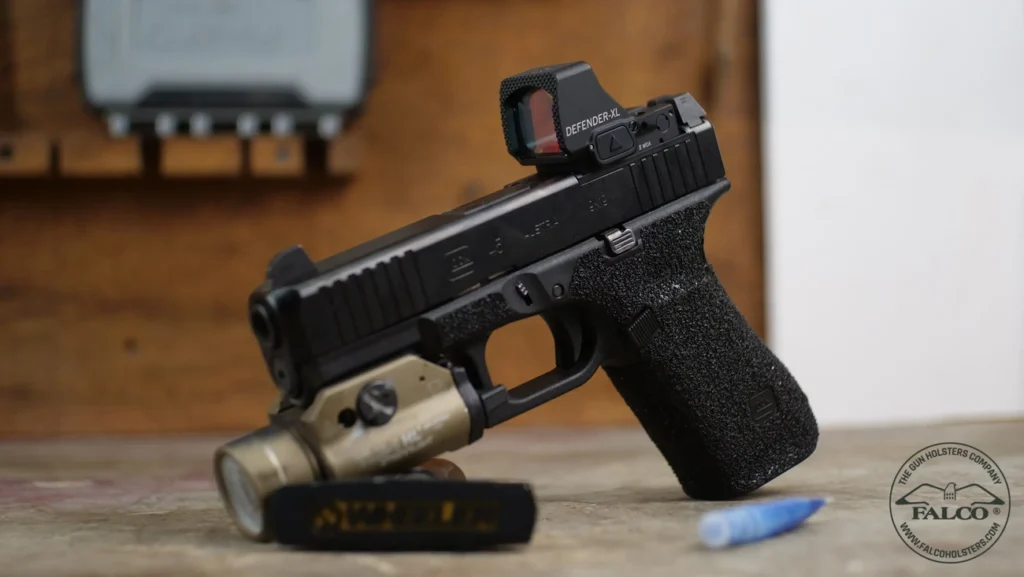
Image Source: Falco Holsters
Red dot optics shift the paradigm from aligning three focal planes to a single point of aim, cutting target acquisition time and maintaining focus where it belongs: downrange.
Popular Red Dot Choices for Competition
The Vortex Defender-XL dominates competition circles because of its panoramic glass, affordability, and mounting versatility. It ships with labeled screws for different pistol models, blue thread-locker pre-applied, and a torque spec of 10 to 12 inch-pounds. The DeltaPoint Pro footprint includes a Glock MOS plate and Picatinny mount in the box.
The Trijicon SRO features a large round window that provides the least obstructed view. One shooter ran this optic flawlessly on a training pistol since 2019 through multiple classes with no hiccups. The Holosun HS507COMP offers a 1.1 x 0.87-inch window for multi-target engagement, with selectable reticles including a 2 MOA dot, 32 MOA circle, or combination of both. Side-loading batteries allow changes without removing the optic from the slide.
Mounting Solutions for Glock Slides
Glock’s Modular Optic System (MOS) accepts nearly every mini-reflex sight using adapter plates. Standard MOS configurations now include a single adapter plate fitting Trijicon, Ameriglo, and Holosun models (except 509). Aftermarket plates from CHPWS range from $49.45 to $87.95, while Forward Controls Design plates run $72.50 to $90.00.
The Aimpoint A-CUT system mounts directly to the pistol without adapter plates, creating a secure connection through a patented wedge design.
Zeroing and Sight Alignment
Competition shooters should zero at distances matching their typical engagement ranges. A 15-yard zero offers reliable performance from close range out to 25+ yards with minimal deviation. For precision work, a 25-yard zero provides the flattest trajectory from 5 to 50 yards.
At 10 yards, 1 MOA equals one-tenth of an inch. At 25 yards, 1 MOA equals one-quarter inch. Bore sighting speeds the process but requires range confirmation with 5-round groups from a stable rest.
Co-Witnessing with Iron Sights
Co-witnessing allows backup iron sights to function if the red dot fails. Lower 1/3 co-witness shows iron sights over the optic body with tritium lamps completely clearing. Absolute co-witness places sight bodies at approximately 50% of the optic window. Standard Glock battle sights typically sit too low and get blocked by most red dot bodies.
Compensator for Recoil Management
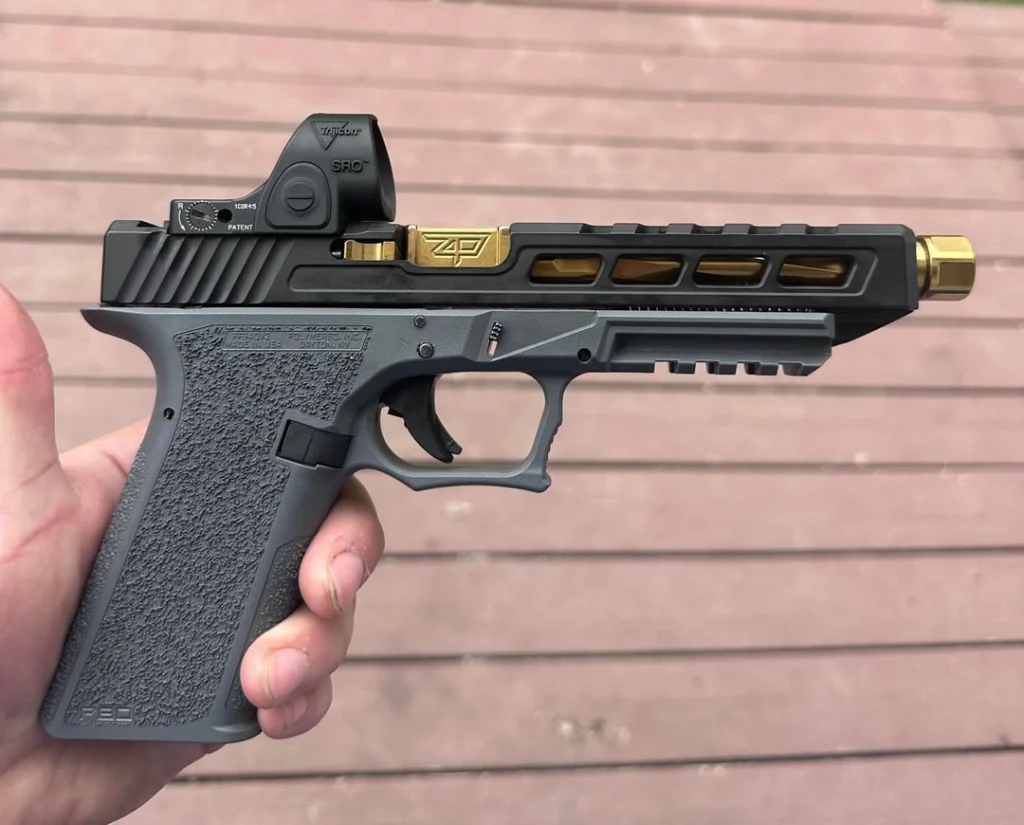
How Compensators Work
Compensators redirect expanding gasses upward and sideways as rounds fire, creating downward force that counteracts muzzle rise. The device captures gas exiting behind the bullet through ports on the top or sides, which reduces muzzle flip and improves sight tracking during rapid fire. This redirection allows sights to return to target more quickly, improving split times between shots.
Top Compensator Models for Glocks
The Radian Afterburner + Ramjet delivers up to 44% recoil reduction with 124-grain ammo using an innovative threadless design. Priced around $400, this system reflects premium engineering. The Herrington Arms HC95 cuts recoil by 28% at $94.99, while the HC9C weighs just 0.6 ounces and eliminates vertical and horizontal recoil.
The Strike Industries Mass Driver mounts on the guide rod instead of the barrel, eliminating the need for a threaded barrel. Its forward-moving design counters the slide’s rearward movement through opposing forces. The Agency Arms 417 features dual ports that vent gasses upward with an optional front sight mount.
For maximum effectiveness, the KE Arms Carry Comp reduced muzzle rise by 57%, from 15.39 degrees to 6.66 degrees. The PMM Micro advertises 30-35% recoil reduction with NATO-spec ammo, priced at $320 to $360. The Griffin Micro Carry Comp measures just 0.625 inches overall and reduced muzzle rise from 13.99 degrees to 8.3 degrees.
Installation Requirements
Most compensators require threaded barrels with common 1/2×28 thread patterns for 9mm Glocks. Installation involves verifying thread compatibility, applying high-temperature Loctite 272 to threads, and ensuring proper alignment. Thread the compensator until no space remains for another complete revolution without contacting the slide. Blue Loctite requires 24-hour curing before firing. Threadless systems use set screws tightened to 33 inch-pounds of torque with ball bearings for alignment.
Recoil Reduction Benefits
Quality compensators reduce felt recoil by 10% to 50%, depending on model, ammo type, and setup. Faster follow-up shots stem from flatter shooting characteristics and improved sight realignment. Compensators work best with higher-pressure loads like +P ammo, as increased gas pressure maximizes recoil reduction benefits. In competitive shooting, compensators provide approximately 25% time advantage in split times.
Lightened or Skeletonized Slide
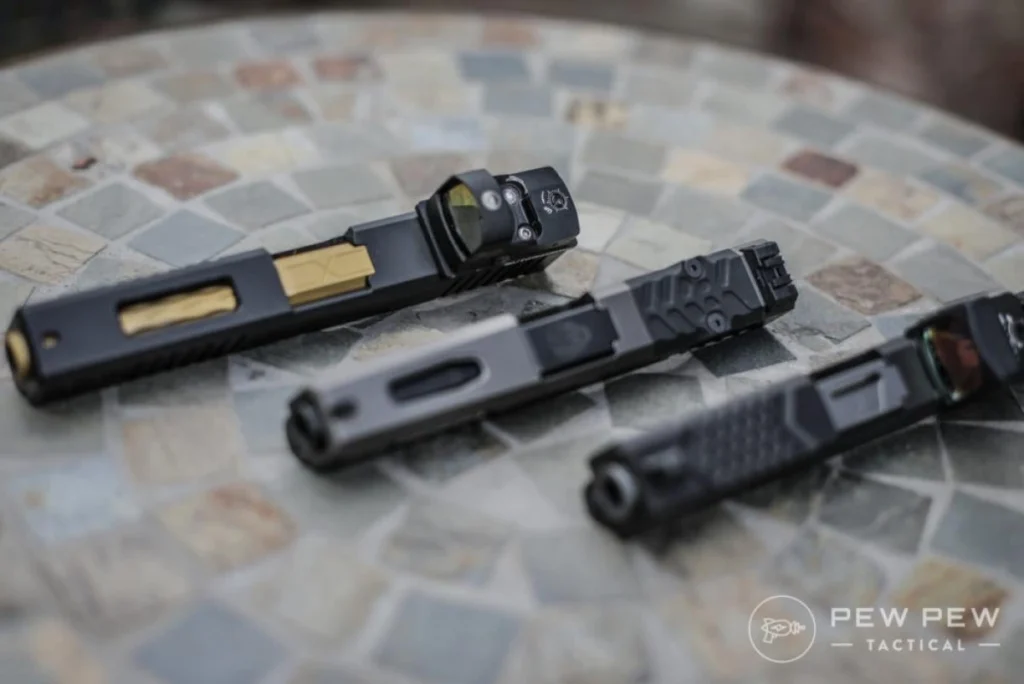
Image Source: Pew Pew Tactical
Skeletonized slides address a problem stock Glocks never solved: excessive reciprocating mass that fights your sight picture during rapid fire.
Weight Reduction Benefits
Reducing slide weight keeps the gun flatter through the entire shooting cycle. A standard Glock 34 slide weighs 12.15 ounces from the factory; aftermarket options drop that to 9.8 ounces. For the Glock 19, you’ll see reductions from 11.8 ounces down to 10.8 ounces. Less reciprocating mass means sights are less inclined to dip as the slide returns to battery.
In reality, the performance difference shows up most noticeably when running lighter competition loads. With a lightened slide, the same gun that required a #10 spring to run 115 power factor steel ammo will run 110 power factor reliably with #12 springs. Coupled with proper tuning, this provides consistent cycling across a broader range of ammunition.
Popular Slide Manufacturers
Brownells offers regular, optics-cut, and windowed varieties with reliable tolerances. Lone Wolf Distributors provides laser engraving, custom porting, and complete slide customization including RMR cuts. Zev Technologies produces the Dragonfly, a stainless steel slide with extensive cutouts that maintain structural integrity while improving barrel cooling. Gray Ghost Precision delivers ultra-tight tolerances and performs consistently on both Glock and Polymer80 frames. Killer Innovations slides come pre-cut for Trijicon RMR and Leupold DeltaPoint Pro optics. Spinta Precision provides impressive finish selections and broad optic cut options.
Optics-Cut Considerations
OEM MOS cuts measure .197 to .200 inches deep. Aftermarket machining typically ranges from .125 to .150 inches, which positions red dots higher above the slide surface.
Impact on Cycling Speed
Lighter slides cycle faster, particularly with reduced-power competition loads. This translates to less muzzle flip and improved follow-up shot speed.
Competition Glock 34 Barrel Upgrade
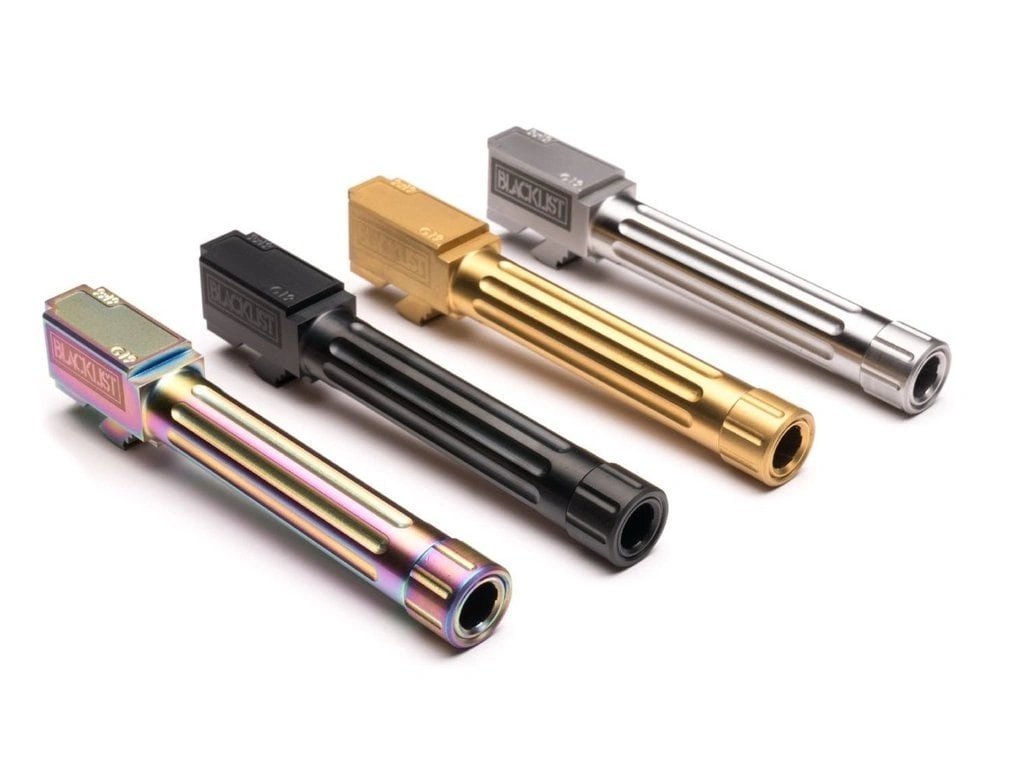
Match-grade barrels replace the polygonal rifling that limits your ability to shoot lead ammo and push accuracy beyond factory specifications.
Match-Grade Barrel Features
Premium barrels start with certified 416R stainless steel bar stock, the same material developed for match-grade rifle barrels. Wilson Combat machines theirs from aircraft-grade stainless steel blanks and heat-treats to R/C 40 for extended service life. Manufacturing tolerances determine performance. Wilson Combat holds critical dimensions to less than .0005″, while ZEV Technologies maintains final dimensions of +/- 0.0002″.
Button rifling irons the pattern into the barrel instead of cutting it, creating tighter chambers that give competitive shooters measurable advantages. Conventional land-and-groove rifling works with lead ammunition, unlike factory polygonal rifling. ZEV barrels undergo double-honing until reaching a minimum 16 RA surface finish.
Accuracy Improvements
Quality match-grade barrels consistently cut groups in half at 50 yards. Wilson Combat routinely obtains test groups of 1/2″ at 25 yards. Testing at Fire-4-Effect’s Proving Grounds found barrels themselves were the largest determining factor in accuracy, with chamber size, throat depths, and internal finishes making significant contributions. A tighter barrel-to-slide fit of .001-.003 delivers optimal accuracy.
Threading for Compensators
Threaded barrels accept suppressors and compensators using standard 1/2-28 thread pitch patterns. Griffin Advanced Threaded Match barrels are precision-machined from 416R chromium stainless steel.
Best Barrel Brands
KKM Precision uses button rifling and vacuum-tempering with SAAMI spec match chambers. Faxon barrels feature PVD or black Nitride coating with better-than-factory tolerances guaranteeing tighter lockup. Lone Wolf offers salt bath nitrided, fluted designs compatible with all Glock generations. Agency Arms Syndicate barrels use 416R stainless with 1:10 twist rate broached rifling.
Extended Magazine Release
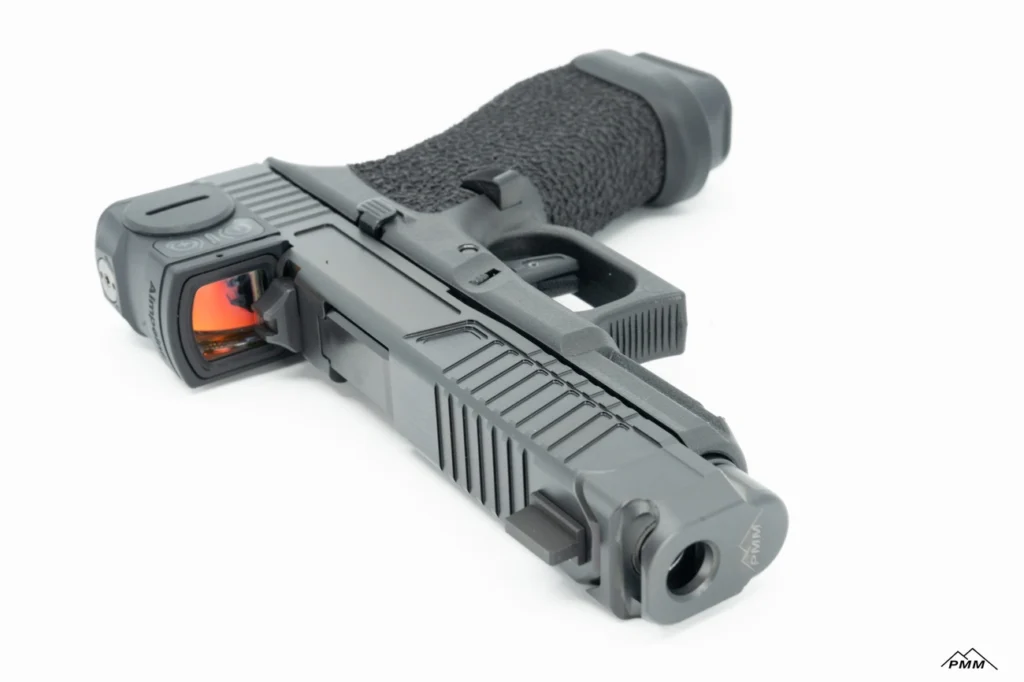
Image Source: Parker Mountain Machine
Faster reloads separate winners from runners-up when stages demand multiple magazine changes under time pressure.
Faster Reload Benefits
Extended magazine releases cut emergency reload times by 0.15 to 0.25 seconds and speed reloads by 0.10 to 0.15 seconds per reload. On a typical IPSC stage requiring 2-3 reloads, this saves 0.30 to 0.75 seconds. Beyond raw speed, the larger button reduces reload failures during matches and maintains grip consistency, which reduces time needed to reacquire sight picture after reloads.
Installation Process
Remove the slide and work only with the frame. The magazine release has a cut in the bottom for a flathead screwdriver. From the top view, insert the screwdriver head vertically into the spring area to create lever action. Hold down the right side of the magazine release, push to the right and outward so the pin comes out. Remove the stock release and insert the extended version. Position the screwdriver from the top, move the pin toward you over the magazine release, then push it in using reverse lever action until it falls into the groove.
Ergonomic Design Features
Extended releases add 3 to 6mm beyond factory length, moving the contact point closer to natural thumb position. Popular options include Tyrant CNC’s machined aluminum releases, Agency Arms models for Gen3, Gen4/5, and 43X/48, Ghost Inc. EMR releases, and Hyve Technologies Gen4/5 releases machined from 6061 aluminum. NDZ Performance offers Standard, Plus, and Extended sizes to accommodate different ergonomic preferences.
Competition-Legal Considerations
Production Division explicitly prohibits extended magazine releases. Standard Division, Classic Division, and Open Division allow them without restriction. IDPA permits extended releases provided the button doesn’t exceed 0.2 inches protrusion from the frame and isn’t oversize in diameter.
Competition-Grade Magwell

A magwell transforms the magazine well opening from a precise insertion point into a forgiving funnel that guides magazines home under stress.
Magwell Design and Function
In essence, the magwell performs one job: guide a magazine into perfect alignment with the mag catch in the shortest possible time. The funnel geometry converts fast, imprecise hand motion into precisely seated magazines through several critical dimensions. Flare angle controls how aggressively the funnel catches the magazine, with shallow angles of 8-12° offering concealment-friendly profiles while sharper angles of 18-30° guide faster but print more under cover garments. The throat width maintains 0.2-0.5mm clearance over the magazine body to reduce binding without excessive wobble. A rounded lead-in with 1.5-3.0mm filet transitions the magazine from flare to throat, creating smooth insertion.
Speed Reload Advantages
Controlled funnel geometry shortens insertion angle sensitivity by 6-8 degrees, consequently reducing average reload time by 0.15-0.25 seconds for trained shooters. This translates directly from geometry, not training alone. The wider funneled entry creates a larger target zone for magazine insertion, making reloads quicker and more intuitive without taking eyes off the next target.
Installation Steps
Installation takes approximately 30 seconds with one screw and included wrench. Push the magwell over the bottom of the grip until the hole in the magwell lines up with the hole in the back of the grip. Secure with the screw without over-tightening. Some models require snapping into place with firm pressure as flares on the sides keep the magwell from sliding into proper position initially.
Popular Magwell Options
Taran Tactical Competition Lightning features aggressive flared design for generous opening and improved pinky positioning. Overwatch Precision includes chamfered cuts for stripping stuck magazines. Agency Arms offers compact design for concealed carry applications. ZEV Technologies uses 6061 aluminum for exceptional durability. Tyrant Designs provides aluminum construction at $69.95 with competitive pricing compared to $100+ alternatives.
Upgraded Guide Rod Assembly
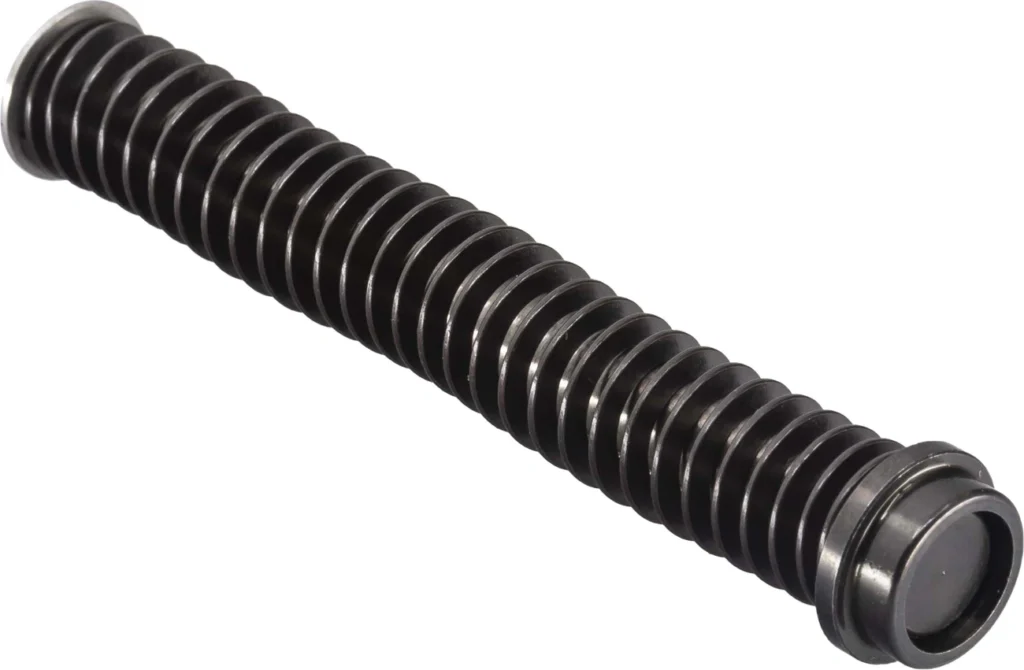
Factory polymer guide rods flex under repeated stress, introducing inconsistency that competition shooters can’t afford.
Tungsten vs Steel Options
Tungsten guide rods weigh 4-5 times more than OEM plastic versions. A Pure Tungsten uncaptured rod with 13# spring weighs 3.6 ounces compared to 2 ounces for standard tungsten. In fact, one measurement showed factory guide rods at 20 grams versus 85 grams for Pure Tungsten. This density advantage stems from tungsten’s material properties, though it comes at higher cost and increased machining difficulty.
Stainless steel guide rods eliminate flex without adding excessive weight. They provide durability upgrades over stock components and allow easier spring swaps for shooters who tune setups frequently. Conversely, tungsten offers superior muzzle flip reduction but remains prone to cracking under overpressure loads due to its ceramic-like properties.
Weight and Balance Benefits
The dead weight positioned under the barrel reduces recoil and muzzle flip, allowing faster, more accurate follow-up shots. Testing with Pure Tungsten on a Glock 34 improved grouping from lucky 5-hit accuracy to 17 shots within a 5-inch group. A Glock 19 Gen 5 MOS setup reduced muzzle rise significantly while maintaining zero cycling issues with 115-grain and 150-grain ammo.
Compatibility with Different Models
Guide rods fit Gen 1-4 models including G17, G19, G22, and G23, with separate options for Gen 4 and Gen 5 configurations. The DPM system works across multiple 9mm Glocks and proved reliable through 62,000+ rounds in testing without frame damage.
Installation Tips
DPM systems include multiple springs for fine-tuning, with longer springs providing heavier pound ratings. Use small washers for 9mm factory loads and big washers for .40 S&W and .357 Sig calibers. Cycle the slide several times before loading to verify proper installation.
Competition Glock Sights

Image Source: Dawson Precision
Sight selection determines how quickly you acquire targets and maintain focus during rapid-fire strings.
Fiber Optic vs Night Sights
Fiber optic sights gather ambient light to create bright, high-visibility sight pictures that excel in well-lit environments. Competition shooters favor fiber-optic front sights paired with blacked-out rear sights, ensuring focus remains on the front sight for fast, accurate target acquisition. In contrast, night sights rely on tritium gas that produces constant glow regardless of lighting conditions. Tritium maintains visibility in low-light scenarios but costs more and gradually loses brightness over approximately 12 years.
Sight Picture for Speed Shooting
Competition-oriented setups use blacked-out rear sights with high-visibility fiber optic front sights. This configuration draws your eye immediately to the front sight, eliminating rear sight distraction during rapid target transitions.
Installation and Adjustment
Glock sights rank among the easiest pistol sights to install without expensive tools. Slip-fit designs complete installation in under 15 minutes. File-to-fit methods require careful material removal and light hammer strikes on the dovetail. Centering verification uses three methods: eyeballing, pencil marking the slide center, or calipers measuring equal dovetail space.
Best Sight Options
Trijicon HD XR features narrow front posts 0.022 inches thinner than standard sights for faster acquisition. Dawson Precision offers dedicated competition sight sets for Glock Gen 1-5 models.
Enhanced Connector and Spring Kit
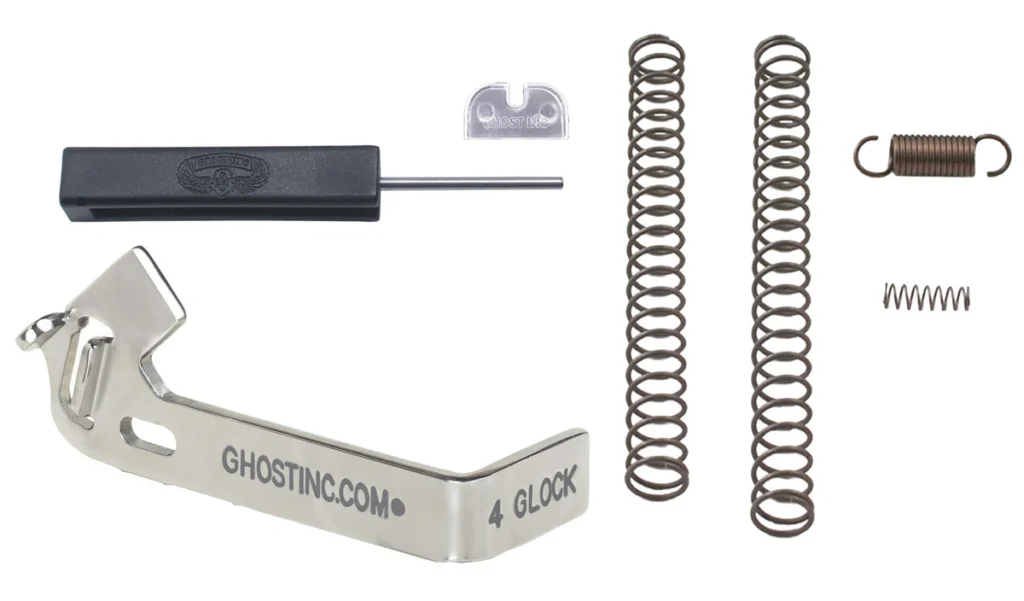
Image Source: Ghost Inc.
Connectors and springs work together to determine how your trigger breaks and resets between shots.
Trigger Feel Improvements
Replacing the standard 5.5-pound connector with a 3.5-pound aftermarket option reduces trigger pull weight by approximately one pound. Ghost Ultimate 3.5 lb connectors feature slits that supposedly self-clean, while the Ghost Edge and Evo Elite use innovative ledge placement for crisper breaks. Standard connectors paired with standard trigger springs produce 5.5-pound pulls, while minus connectors with standard springs drop to 4.5 pounds.
Spring Weight Options
Heavier 6-pound trigger springs actually reduce trigger pull weight by close to a pound. In contrast, NY1 trigger springs increase pull to 9 pounds and NY2 springs reach 11 pounds. Lighter striker springs of 4 to 4.5 pounds reduce trigger pull by approximately 16 ounces per step, though they risk light primer strikes with hard primers.
Installation Considerations
Drop-in connectors like the Ghost 3.5 lb require no fitting. Fitted connectors (Evo Elite, Pro, Rocket) need Trigger Control Tab shortening via filing or Dremel. Fire at least 300 rounds of carry ammunition to ensure proper functioning after installation.
Legal and Safety Notes
Reduced trigger pull weight increases arguments that guns fired unintentionally in criminal and civil cases. Test modified triggers thoroughly and articulate why modifications improve safety.
Grip Enhancements and Stippling

Factory Glock grip texture fails under pressure when hands get sweaty during extended match stages.
Grip Tape vs Professional Stippling
Grip tape provides non-permanent enhancement at $15-25 per application. Talon Grips and Handleit Grips offer pre-cut options requiring less than 15 minutes to install. Whereas tape wears out after a few years of heavy use, professional stippling ranges from $100 to $350 and lasts indefinitely. Stippling improves traction by melting and reshaping the polymer, creating a rougher surface that reduces slippage during rapid firing. Note that stippling voids warranties and permanently alters the frame.
Texture Patterns for Competition
Competition shooters prefer aggressive stipple patterns for maximum grip. Professional services offer laser stippling starting at $125 for basic patterns, with custom designs available. The texture can be tailored to hand size and grip preferences, providing personalized feel that mass-produced options cannot match.
Application Methods
DIY stippling uses a soldering iron to burn dot patterns into the polymer. Professionals employ laser systems producing consistent, durable results. Frame modifications like trigger guard undercutting alleviate “Glock knuckle”, while finger groove removal creates straight front straps.
Maintenance and Durability
Professional stippling holds up 7-10+ years with minimal wear. Textured surfaces require regular cleaning as grooves collect debris. Quality work includes lifetime warranties covering touch-ups.
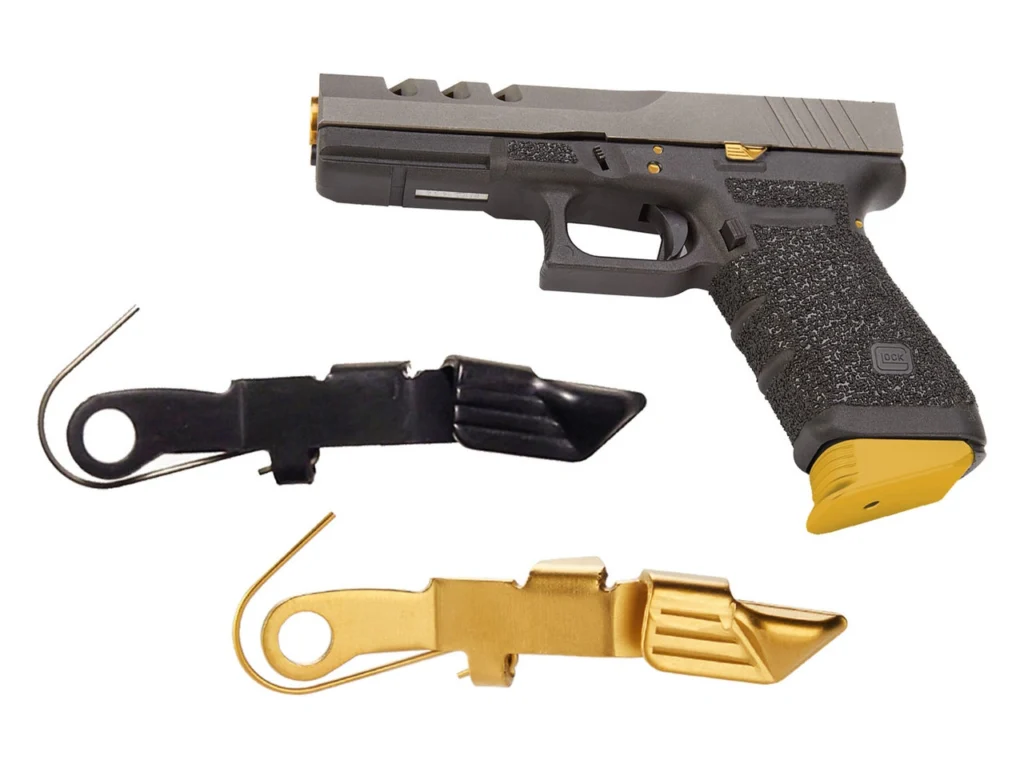
Extended Slide Stop Lever
Faster Slide Manipulation
Stock slide stops require precise thumb placement and often force you to break your shooting grip. Extended versions position the lever closer to your natural thumb position, allowing slide release with just a flick downward or upward to lock it back. With very little practice, you can execute either motion without adjusting your grip.
The larger, more positive contact surface enables faster, more confident slide manipulations. This simple upgrade can dramatically improve your reloading speed, particularly during emergency reloads when fractions of a second matter.
Ergonomic Benefits
Premium extended slide stops feature 1.5mm additional surface area compared to factory levers. CNC-machined versions include raised texturing that prevents slippage during fast reloads or in wet conditions. The extended profile allows easier thumb access even when wearing gloves, maintaining consistent operation regardless of environmental factors.
Installation Process
Installation takes approximately two minutes with basic tools. Remove the two pins using FIFO method (first in, first out), starting with the top small pin. Move the slide stop lever up and down while maintaining pressure on the larger pin to ease removal. Insert the small pin first, then position the extended lever underneath it before installing the large pin.
Competition Advantages
Extended levers maintain proper grip while quickly releasing the slide after reloads, keeping your focus downrange instead of on mechanical manipulation.
Performance Recoil Spring Assembly
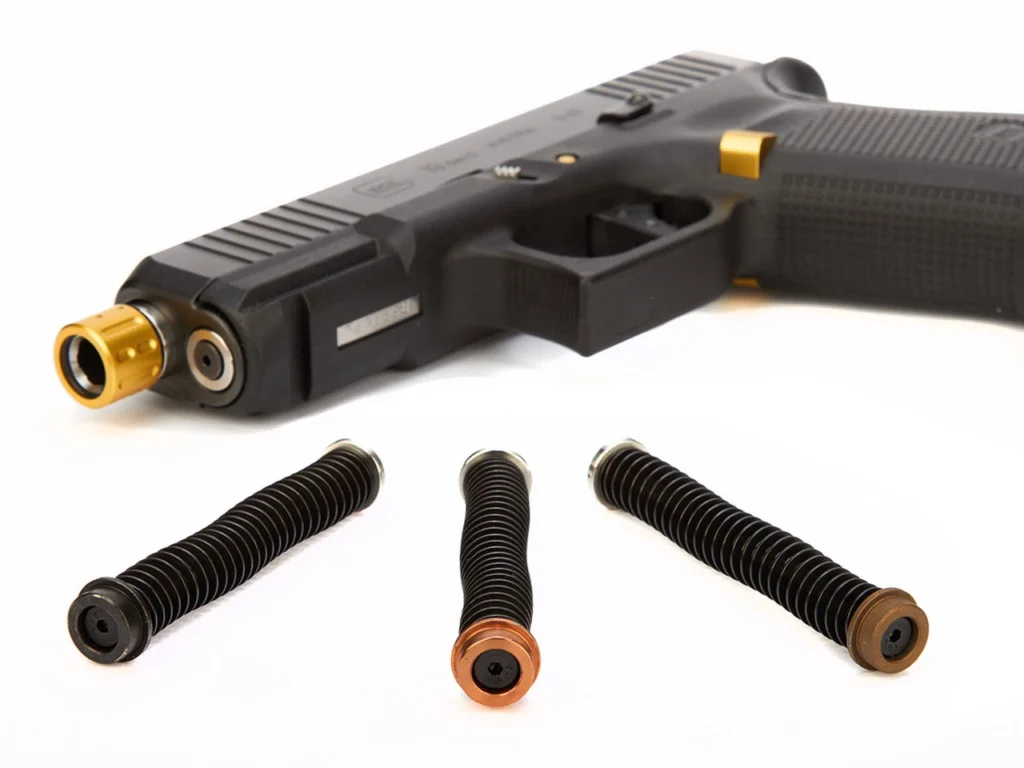
Tuning your recoil spring assembly ranks among the most impactful modifications serious competitors overlook when building a competition glock.
Spring Weight Selection
Factory Glock springs run 15 to 18 pounds for 9mm pistols. Competition shooters typically drop to 9-11 pounds for minor power factor reloads or 11-13 pounds for major loads. Factory 115-grain ammunition performs best with 13-15 pound springs. Lightweight options ranging from 11 to 14 pounds allow faster slide cycling with reduced-power match loads, whereas heavy springs of 19-24 pounds support suppressors and hot ammunition.
Cycling Reliability
The golden rule: use the lightest spring that still cycles reliably and fully returns to battery. Springs that are too light cause failures to chamber or eject as the slide moves rearward with excessive force. Overly heavy springs prevent the slide from traveling fully rearward, inducing malfunctions with lighter practice ammunition.
Compatibility with Modifications
Match your spring weight to your specific setup. Compensators require lighter springs since gas redirection reduces recoil energy available for cycling. Heavier springs support hotter rounds or help manage slide speed in compensated builds.
Tuning for Competition Loads
Consequently, proper tuning optimizes recoil impulse, slide speed, and dot tracking. Quality chrome silicon springs from manufacturers like ISMI last over 100,000 rounds. Replace OEM springs when they lose 0.500 inches of free length or reach 50,000 rounds.
Comparison Table
Comparison Table: 13 Essential Competition Glock Upgrades
| Upgrade | Primary Benefit | Key Performance Metric | Popular Brands/Models | Price Range | Installation Complexity |
|---|---|---|---|---|---|
| Competition Glock Trigger Upgrade | Shorter reset, crisp break, lighter pull weight for faster split times | Reduces pre-travel by ~30%; pull weight 3-4.1 lbs vs stock 5.5-6 lbs | Timney Alpha Competition, Glock Performance Trigger, Ghost 3.5 lb Connector, Zev Pro Series Ultimate Kit | $115.50 – $300+ | 60-90 minutes; requires careful function testing |
| Red Dot Optics and Mounting System | Single point of aim, faster target acquisition | Cuts target acquisition time (specific metric not mentioned) | Vortex Defender-XL, Trijicon SRO, Holosun HS507COMP | Not mentioned | Requires MOS slide or adapter plates; torque to 10-12 inch-pounds |
| Compensator for Recoil Management | Reduces muzzle rise and improves sight tracking | 10-57% recoil reduction; ~25% time advantage in split times | Radian Afterburner + Ramjet, KE Arms Carry Comp, PMM Micro, Herrington Arms HC95 | $94.99 – $400 | Requires threaded barrel; 24-hour Loctite curing |
| Lightened or Skeletonized Slide | Reduced reciprocating mass for flatter shooting | Weight reduction from 12.15 oz to 9.8 oz (G34); 11.8 oz to 10.8 oz (G19) | Brownells, Lone Wolf, Zev Technologies Dragonfly, Gray Ghost Precision, Killer Innovations | Not mentioned | Drop-in replacement; verify optics cut depth |
| Competition Glock 34 Barrel Upgrade | Improved accuracy, lead ammo compatibility | Groups cut in half at 50 yards; 1/2″ groups at 25 yards | KKM Precision, Wilson Combat, Faxon, Lone Wolf, Agency Arms, ZEV Technologies | Not mentioned | Drop-in replacement; verify threading for compensators |
| Extended Magazine Release | Faster magazine changes | 0.15-0.25 seconds faster emergency reloads; 0.10-0.15 seconds faster speed reloads | Tyrant CNC, Agency Arms, Ghost Inc. EMR, Hyve Technologies, NDZ Performance | Not mentioned | Simple installation with screwdriver; ~5 minutes |
| Competition-Grade Magwell | Guides magazines for faster, more reliable insertion | 0.15-0.25 seconds faster reload times; 6-8 degrees wider insertion angle | Taran Tactical Competition Lightning, Overwatch Precision, Agency Arms, ZEV Technologies, Tyrant Designs | $69.95 – $100+ | 30 seconds; one screw installation |
| Upgraded Guide Rod Assembly | Reduces muzzle flip and recoil through added weight | Tungsten weighs 4-5x more than OEM (85g vs 20g) | Pure Tungsten, DPM system, Stainless steel options | Not mentioned | Simple replacement; cycle slide to verify |
| Competition Glock Sights | Faster target acquisition with high-visibility front sight | Not mentioned | Trijicon HD XR, Dawson Precision Competition Sets | Not mentioned | 15 minutes for slip-fit; file-to-fit requires more time |
| Enhanced Connector and Spring Kit | Lighter, crisper trigger pull | Reduces pull weight by ~1 lb (5.5 lbs to 4.5 lbs with minus connector) | Ghost Ultimate 3.5 lb, Ghost Edge, Ghost Evo Elite | Not mentioned | Drop-in for most; some require fitting |
| Grip Enhancements and Stippling | Improved traction and control, especially with sweaty hands | Not mentioned | Talon Grips, Handleit Grips (tape); Professional laser stippling services | $15-25 (tape); $100-350 (professional stippling) | 15 minutes (tape); professional service required for stippling |
| Extended Slide Stop Lever | Faster slide manipulation without breaking grip | 1.5mm additional surface area vs factory | CNC-machined options with raised texturing | Not mentioned | 2 minutes with basic tools |
| Performance Recoil Spring Assembly | Optimized cycling for competition loads | Factory 15-18 lbs; competition 9-13 lbs depending on load | ISMI chrome silicon springs | Not mentioned | Simple replacement; requires tuning to ammunition |
Conclusion
At any rate, you don’t need all 13 upgrades to start winning matches. Pick the modifications that address your specific weaknesses first. Take the case of trigger upgrades and compensators delivering the most dramatic improvements for split times and recoil management. Barrels and sights follow closely for accuracy gains.
Start with one or two upgrades, test them thoroughly at the range, then expand your setup as budget allows. Each modification builds on the others, thus creating a competition glock that responds faster and shoots flatter than anything you’ll find in factory configuration. Your times will reflect the difference once you dial in the right combination for your shooting style.
FAQs
Q1. What makes the Glock 34 ideal for competition shooting? The Glock 34 features a longer barrel and sight radius that enhance accuracy, making it a top choice among competitive shooters. Its design allows for easier customization with aftermarket parts like triggers, compensators, and optics, which are essential for achieving faster split times and improved performance in matches.
Q2. How much can a compensator reduce recoil on a competition Glock? Quality compensators can reduce recoil by 10% to 57%, depending on the model and ammunition used. For example, the KE Arms Carry Comp reduced muzzle rise from 15.39 degrees to 6.66 degrees, while most competition-grade compensators provide approximately 25% faster split times during rapid-fire stages.
Q3. What trigger pull weight is best for competition Glocks? Competition shooters typically prefer trigger pull weights between 3 and 4.5 pounds, compared to the factory 5.5-6 pound pull. Lighter triggers with crisp breaks and shorter reset distances enable faster follow-up shots and improved accuracy, with options like the Timney Alpha Competition offering 3-pound pulls and minimal pre-travel.
Q4. Do I need a threaded barrel to install a compensator on my Glock? Most compensators require a threaded barrel with a 1/2×28 thread pattern for 9mm Glocks. However, some models like the Strike Industries Mass Driver mount on the guide rod instead, eliminating the need for barrel threading while still providing effective recoil reduction.
Q5. How much time can an extended magazine release save during competition reloads? Extended magazine releases can reduce emergency reload times by 0.15 to 0.25 seconds and speed reloads by 0.10 to 0.15 seconds per reload. On a typical match stage requiring 2-3 reloads, this translates to time savings of 0.30 to 0.75 seconds, which can be the difference between winning and placing.
People Also Read: What Are Anime Terms? Essential Japanese Words for Fans